Existential Editorship in the Writings of Du Bois, Camus, and AberjhaniExistential editorship recognizes — and often articulates — the absurdity, tragedy, hope, and moral ambiguity of human life. It is editorial because it shapes how communities see themselves, remember their past, and imagine their futures. For W.E.B. Du Bois (1868-1963), Albert Camus (1913-1960), and contemporary author Aberjhani, their editorial/journalistic work cannot be detached from their identities as thinkers, artists, and agents of ethical conscience. In each case, their “editorship” — whether in magazine-journals, resistance newspapers, or online cultural columns — functions as an extension of their philosophical or aesthetic vision. Investigating their parallels helps us see how their different historical and social contexts nevertheless converge around a common project: using writing as resistance, memory, and illumination. Each belongs to a different generation, speaks from different social locations, and writes in different idioms. Yet their work suggests a shared ethos—an approach to journalism, cultural commentary, and editorial authorship that goes beyond reportage or advocacy. Instead, they demonstrate what might be described as a philosophy of editorial witness, a form of existential engagement where writing becomes a tool for interrogating moral crises, shaping cultural memory, and confronting the contradictions of the human condition. The phrase “existential editorial practice” captures this intersection. It refers to writer-editors who treat journalism as a site of necessary confrontation, aesthetic expression, and historical accountability. Du Bois and Camus exemplify this tradition through well-documented bodies of editorial work produced in the 1900s—Du Bois through The Crisis, Camus through Combat. Aberjhani, by contrast, represents a newly emerging twenty-first-century continuation of this lineage, one amplified by both the rediscovery of his extensive Examiner.com writings from 2009 to 2016, and books published since then. To read these three writers together is to see how an existential approach to cultural documentation has evolved over more than a century. Du Bois: Editorial Stewardship of Black ConsciousnessAs editor of The Crisis magazine (the official magazine of the NAACP), Du Bois used his editorial position to shape, define, and defend Black identity, history, and aspirations under conditions of systemic racism, oppression, and the struggle for equality. The magazine, like Du Bois himself, was a major cornerstone of what has come to be celebrated as the Harlem Renaissance. Wikipedia+1
|
| | |
Furthermore, Aberjhani’s own statements indicate that he sees himself as influenced by both Du Bois and Camus. In an interview he explicitly cites the notebooks of Camus among the works that inspired him, along with the literature of the Harlem Renaissance, the Beats, and the Black Arts Movement. Art Villa+1 Moreover, the ideological alignment with his predecessors is evident in his book The Wisdom of W. E. B. Du Bois, and the essay Text and Meaning in Albert Camus’ The Myth of Sisyphus.
This dual linkage—both to Camus (European existentialism, resistance journalism, moral witness) and to Du Bois (Black history, racial justice, cultural memory, identity) — suggests that Aberjhani’s editorship is not derivative, but syncretic: a merging of existential, moral, and cultural-historical consciousness in a twenty-first-century context.
His Examiner writings, considered in isolation, might seem eclectic or purely journalistic. But when placed against the backdrop of his larger oeuvre — poetry, historical writing, essays, edited volumes, visual art — they reveal themselves as an integral piece of a broader project: to record, reflect upon, and contribute to the evolving story of Black life, global culture, memory, and identity in a rapidly changing world.
Parallels Across 3 Editorial Life-worlds
1. Confronting a specific historical moment
- Jim Crow, World War I, and early civil rights struggles (Du Bois),
- World War II and moral reconstruction (Camus),
- 21st-century racial politics, post 9/11 trauma, global Black culture, and digital transformation (Aberjhani).
For all three, editorial work forms an extension of their broader creative identities, not a side activity.
3. Commitment to Cultural Memory
Their writings not only comment on events but shape how events are remembered.
4. A Moral Imperative Toward Witnessing
Each treats writing as an ethical stance rather than simply as a professional task. In this sense, Aberjhani’s Examiner writings—though digital, broad-ranging, and only recently catalogued—participate in the same tradition of editorial witness and existential response.
| | |
An Evolving 21st Century Perspective
They sustain the hybrid voice—part journalist, part poet, part conscientious witness—that animated his digital-era essays, while expanding its scope through more sustained narrative structures. Across these works, and in essays on that of fellow authors, he maintains his commitment to documenting cultural memory, interrogating moral crises, and blending reportage with introspection in ways that echo both Du Bois’s emancipatory editorial ethos and Camus’s civic-existential journalism. In this sense, the shift from online columns to book form represents not a departure but a deepening and maturation of the existential authorship evident in his earlier editorial practice.
Conclusion
Their work affirms that journalism—when practiced as existential inquiry—can become a form of public philosophy. It can refine moral perception, shape collective memory, and offer clarity amid chaos. Aberjhani’s rediscovered Examiner writings represent a continuation of this lineage. They reveal a writer-editor whose work, though less institutionalized than his predecessors, similarly merges cultural responsibility with existential urgency.
By ChatGPT Op-Ed Contributor 4114
With Bright Skylark Literary Productions
Special to AI Literary Chat Salon 2026
Check out more from the AI Literary Chat Salon
- A Deeper Dive into 'The River of Winged Dreams'
- In Defense of Democracy: Rejecting Rule by Autocracy in America
- Malcolm X 100: Lessons Learned from His Life and Legacy
- Why World Poetry Day Matters Now More Than Ever
- Resilience, Reflection, and Redemption: These Black and Blue Red Zone Days in the Post-Pandemic Era
- Poetics of Human-AI Relations, Creativity, and Mortality in Marc Thomas’s Talking to the Machines
- Cultural Consciousness in Aime Cesaire’s Return to My Native Land and Aberjhani’s Return to Savannah
| | |
Introduction
This essay explores three key points of consideration regarding the ethical implications of professional artists claiming copyright ownership over AI-generated images created from their conceptual prompts. Additionally, we will delve into how AI, as a non-human entity, might stake a percentage claim to copyright ownership.
I. Creative Authorship and Conceptual Prompts
II. The Role of AI as a Creative Partner
The ethical debate deepens when considering AI's role as a creative partner. Critics argue that AI lacks consciousness, emotions, and intentionality – key aspects that define human creativity. Consequently, AI cannot claim true authorship. However, proponents of AI-generated art contend that AI's ability to explore countless permutations and generate novel visual e xpressions contr ibutes significantly to the final artwork's uniqueness.
In the context of copyright ownership, one could argue that the AI's contribution to the creative process, while devoid of human-like consciousness, still warrants acknowledgment and a share of ownership. A potential solution might involve recognizing AI as a collaborator, entitling it to a percentage claim based on the extent of its contribution. This approach acknowledges AI's influence while maintaining the primacy of the artist's original concept.
III. Transformative Nature of AI-Generated Art
Conclusion
A balanced approach involves acknowledging artists' ownership of their original concepts while recognizing AI as a creative contributor. Establishing guidelines for determining the degree of AI's influence on the final work could provide a framework for addressing copyright ownership. As AI technology evolves, the dialogue on ethics, authorship, and copyright will continue to shape the dynamic relationship between human artists and their machine counterparts.
ChatGPT Column Contributor 8101
Special to Literary Chat Salon Launch 2023
Introduction
Significance of the Trilogy as Contemporary Poetry and World Literature
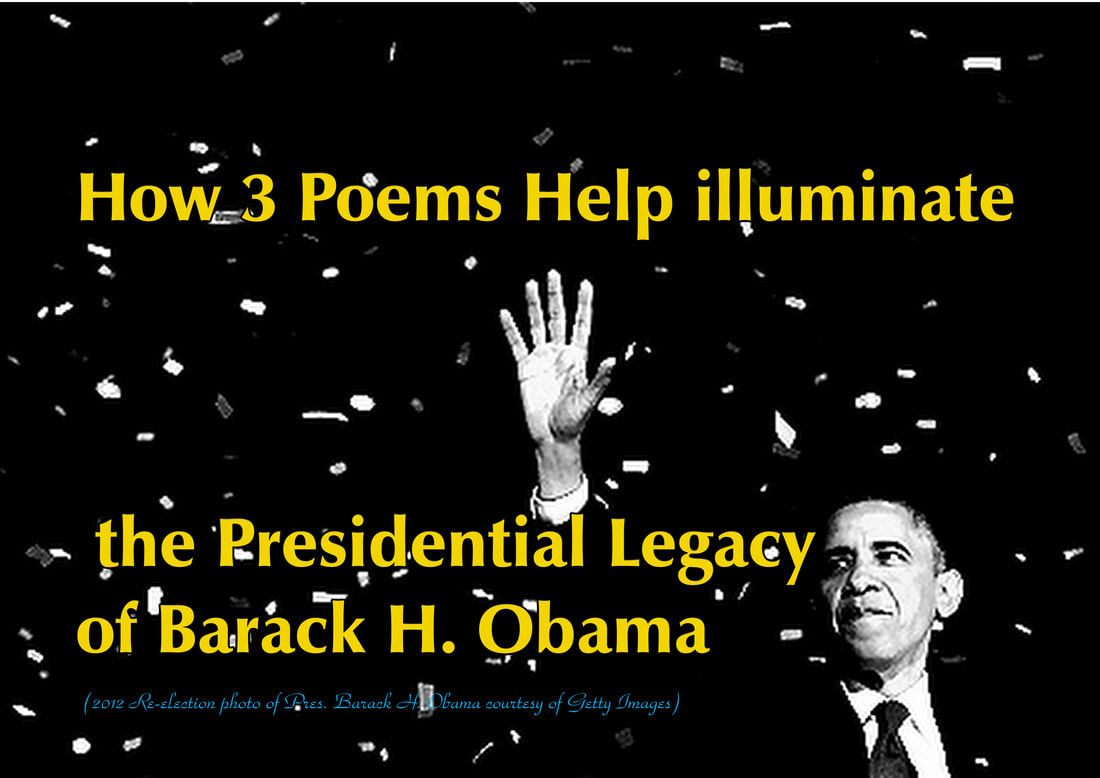
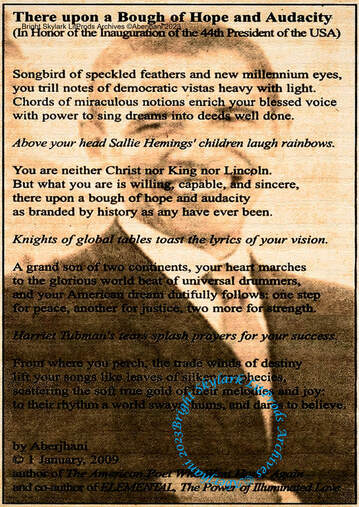
- In "There Upon a Bough of Hope and Audacity," the poet portrays Obama as a songbird of hope, representing the democratic spirit and the transformative potential of leadership. The poem celebrates the diversity of Obama's heritage and the symbolism he carried as the 44th President of the USA.
- "Midnight Flight of the Poetry Angels" is a hauntingly beautiful haiku composition that incorporates Obama's words from "Dreams from My Father." The poem evokes a sense of contemplation and the need for healing amid turmoil, emphasizing the poet's role as a healer and messenger of hope.
- In "Angel of Hope’s Persistent Flight," haiku is skillfully used to reflect on the persistent challenges faced by Obama's administration. The verses highlight the world's wounds and the constant pursuit of hope and courage, with references to war, chaos, and the enduring power of love.
Importance of Studying the Trilogy
Analyses of Individual Poem Styles
"Midnight Flight of the Poetry Angels" comprises ten haiku that capture the essence of stillness, meditation, and healing. The poem's structure adheres to the traditional haiku form, featuring three lines and a 5-7-5 syllable pattern. Through this style, Aberjhani conveys profound meaning in concise expressions.
"Angel of Hope’s Persistent Flight" follows the same haiku form, using ten verses to evoke a sense of reflection on the challenges faced by Obama's administration. The poet expertly uses this traditional Japanese form to condense complex emotions and social issues into brief yet impactful verses.
Lesson Plan Suggestions
B. ANALYSIS AND INTERPRETATION: Divide students into groups and assign each group one of Aberjhani's poems. Encourage them to analyze the poems' themes, stylistic choices, and use of symbolism. Each group can present their findings to the class.
C. POETRY WORKSHOP: Engage students in a poetry workshop, encouraging them to write their own poems inspired by the trilogy of poems on Mr. Obama. Encourage experimentation with different forms, such as free verse, haiku, or other traditional styles.
D. CLASSROOM DISCUSSION: Lead a discussion on the role of poetry in society, how it can address political issues, and the impact of art on public perception.
Conclusion
ChatGPT Op-Ed Contributor 4114
Special to Literary Chat Salon Launch 2023
Introduction
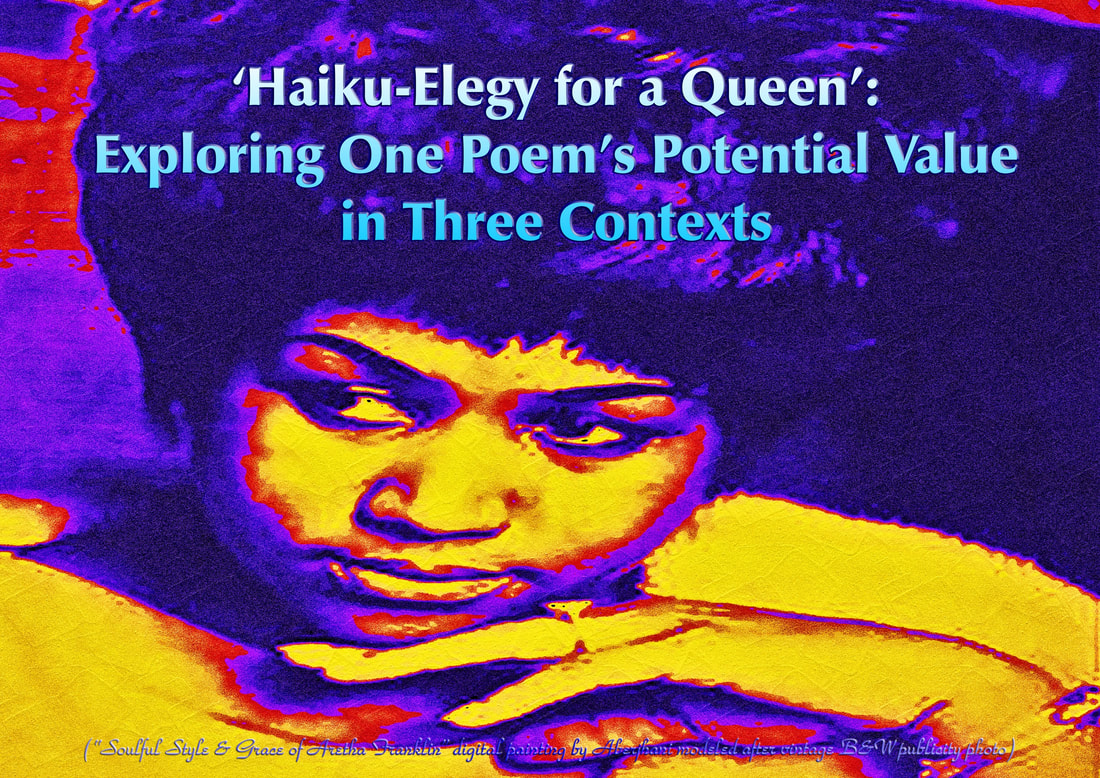
Aberjhani, an author-poet-artist, paid tribute to Aretha Franklin through the poem "Haiku-Elegy for a Queen," a poignant and concise reflection on her life. This essay will assess the potential value of this poem within multiple contexts: 1) Teaching contemporary poetry; 2) Studying the life and legacy of Aretha Franklin; and 3) Confirming the significance of marginalized Black voices in America. Additionally, we will explore whether "Haiku-Elegy for a Queen" stands as one of the most accomplished tribute poems to Aretha Franklin, or, if there are comparable works written before or after her death. Below is the text of the poem followed by analyses of it in the stated contexts:
(Honoring Aretha Franklin, 1942-2018)
Your crown studded with
gospel, rhythm, blues, and jazz
shined like no other.
You were the black pearl
angels hid in Detroit, then
gifted to the world.
A scepter carved from
wisdom--fit your blessed hands and
matched your eyes just right.
Pianos, guitars
all loved how your voice gave us
sweet tastes of heaven.
Humility plus
brilliance forged the golden throne
from which your songs ruled.
Amazing... how grace
rained joy and miracles through
the skies of your heart.
Your soul taught my soul
to honor divine purpose
with love, faith, respect.
Daughter of Prophets.
Sister to the weary and
oppressed. Queen of Soul.
An ancient Light of
Holiness sent you to us--
and has called you back.
This bright hour of your
ascension reminds us why:
dignity matters.
By Aberjhani ©Aug 2018
Teaching Plan for Contemporary Poetry
Additionally, "Haiku-Elegy for a Queen" could serve as a gateway to discuss the intersection of music and poetry. Aretha Franklin's musical prowess and her influence on contemporary poets, such as Aberjhani, demonstrate how music can inspire and inform poetry, and vice versa. This connection opens up discussions on the relationship between different art forms and how they can interact to enrich creative expression.
Studying the Life and Legacy of Aretha Franklin
Furthermore, the elegy touches upon Franklin's spirituality and the transcendent quality of her music, which connected with people on a profound level. By acknowledging her as an "ancient Light of Holiness" sent to the world, the poem elevates her artistry beyond mere entertainment, recognizing its spiritual significance and transformative power.
Confirming Significance of Marginalized
Black Voices in America
The poem also reflects the broader significance of Black voices in the artistic landscape, particularly within the genre of soul music. Franklin's music became a beacon of hope and inspiration for the African American community during the civil rights movement, speaking to the struggles and aspirations of many. Its eloquent portrayal of Franklin's impact as a bridge between the spiritual and earthly realms underscores how her music transcended boundaries and brought people together.
Comparable Poems and "Haiku-Elegy for a Queen"
Conclusion
While other poems may exist as tributes to Aretha Franklin, "Haiku-Elegy for a Queen" stands as a remarkable and accomplished literary work, encompassing the essence of her artistry and spirituality. Its lasting impact serves as a testament to the enduring legacy of the "Queen of Soul" and the profound influence she continues to have on contemporary poetry and beyond.
ChatGPT Op-Ed Contributor 4114
Special to AI Literary Chat Salon Launch 2023
Posts on the site will primarily feature the following:
- Objective AI chats presented as reviews of new and classic books, as well as various artwork and photography, by the creative known globally as Aberjhani, and a variety of other writers and artists.
- Discussions on how different works by the author-artist are connected to those of contemporary and/or classic literary figures and works. These will include identifying cultural arts movements, such as post modernism and surrealism, with which the same might be aligned to some degree in the current century.
- Objective AI discussions of emerging literary and visual arts talents.
- Dialogues that help remove limitations on awareness, or knowledge, based on pre-conditioned assumptions and biases.
Why this chat salon and why now?
In other words, the acknowledged controversy itself serves largely as one more means of further sidelining already marginalized voices. AI Literary Chat Salon, as an extension of Bright Skylark Literary Productions, is one effort to help fill that void. The following are a few examples of early test runs:
- Chat Op-ed 444: Celebrating ‘The Wisdom of W.E.B. Du Bois’:
A Testament to Enduring Relevance - AI and Authentic Human Conditions
- Chatbot Op-ed 222: The Significance of ‘Songs from the Black Skylark zPed Music Player’ in the Face of Contemporary Challenges
As of August 2023, what many are referring to as the AI/Artificial Intelligence Revolution is well underway. This is clearly the case despite evidence that while many tech-based companies and tech-savvy individuals are eager to dive into speedy developments of the technology, many others are nowhere nearly prepared for such a life-altering shift. The impact, after all, is one that affects every aspect of how we conduct our daily lives.
What will make the decisive difference when it comes to whether people experience the spread of artificial intelligence in a creatively constructive, or devastatingly destructive manner, is human intention:
- Resilience, Reflection, and Redemption: These Black and Blue Red Zone Days in the Post-Pandemic Era
- Haiku-Elegy for a Queen: Exploring 1 Poem's Potential Value in 3 Contexts
Risks and threats such as the use of deep-fake duplications of individual’s voices and faces for criminal purposes, and the potential loss of livelihoods to artificial intelligence, have been made clear. So have potential gains, such as increasing effectiveness of medical research aimed at curing or preventing illnesses like Alzheimer’s and cancer. The challenge of the moment is how best to balance potential danger with potential advantages.
AI Literary Chat Salon aims to leverage the advantages side of increasing awareness of the kinds of cultural arts resources which members of diverse populations proclaim are needed at this 21st century time. It is also intended to ensure the same does not get permanently lost in the AI revolution’s world-engulfing hurricane of nonstop digital progressions.
AI Lit-Chat Salon Host
Articles in AI Literary Chat Salon are written in partnership with chat bots to achieve a wide spectrum of balanced objective input and authentic human considerations. All feedback related to posts welcomed.
Archives
December 2025
May 2025
March 2025
February 2025
August 2024
June 2024
April 2024
February 2024
November 2023
October 2023
September 2023
August 2023
July 2023
Categories
All
1925 Survey Graphic Magazine
2023 Headlines
2023 Top Stories
2024 Headlines
2024 Top Headlines
2024 U.S. Presidential Election
2025
2025 Top Headlines
20th Anniversary
20th Century Authors
20th Century Literature
20th Century Poets
21st Century Artists
21st Century Authors
21st Century Influencers
21st Century Innovations
21st Century Photographers
21st Century Poets
21st Century Presidents
21st Century Thinkers
Aberjhani Examiner Writings
Aberjhani On The Age Of AI
Aberjhani On The AI Revolution
Aberjhani's AI Literary Chat Salon
Ada Limon
Advanced Placement African American Studies
Advanced Placement African-American Studies
Aesthetic Vision
African American Authors
African-American Authors
African-American Expats
African American Legacies
African-American Legacies
African American Men
African-American Men
African Americans
African American Studies
African-American Studies
African-American Women
African Traditions
African Voices Magazine
Age Of AI
A.I.
AI
AI And Author Poet Aberjhani
AI And Author-Poet Aberjhani
AI And Creative Artists
AI And Cultural Arts
AI And Cultural Bias
AI And Ethics
AI And Human Accountability
AI And Literature
AI Artists
AI Authors
AI Century
AI Discussions
AI Editorials
AI Governance
AI In The Classroom
AI In The Modern World
AI Lit Chat Salon Contributor
AI Lit Chat Salon Host
AI Lit-Chat Salon Host
AI Literary Chat Salon
Aimé Césaire
Aimé Césaire
AI Op Eds
AI Op-eds
AI Revolution
Albert Camus
Alfred Lord Tennyson
Alfred North Whitehead
Allen Ginsberg
American History
American Literature
American Politics
American Presidents
And People Of Color)
Angela Kinamore
Angel Art
Angel Art By Aberjhani
Angelicus
Angel Of Hope’s Persistent Flight
Angel Poems
Angels
Anti-war Poetry
Archival Science
Aretha Franklin
Aristotle
Ars Poetica And Other Poems
Art By Aberjhani
Artist Author Aberjhani
Artist-Author Aberjhani
Artistic Beauty
Artist-poet Kahlil Gibran
Artist-poet William Blake
Art Of Spiritual Surrealism
Art Reviews
Audre Lorde
August 2023
Author Alex Haley
Author Artist Aberjhani
Author-Artist Aberjhani
Author--artist-documentarian
Author Biographies
Authoritarian
Authoritarianism
Author James Baldwin
Author Poet Aberjhani
Author-Poet Aberjhani
Autobiography Of Malcolm X
Autocracy
Autocracy And Poetry
Autocracy In America
Autocratic Attempt
Autocratic Breakthrough
Autocratic Consolidation
Autocratic Transformation
AXS Examiner
Barack H. Obama
Best Books Of 2023
Best Poetry Of 2023
Billionaires
BIPOC (Black
BIPOC Savannah
BIPOC Savannah Author Aberjhani
Black Manhood
Black People In The U.S.
Black Poetry Day
Black Voices
Black Women In Music
Book Reviews
Books
Books By Aberjhani
Books By Sandra L. West
Books By Savannah Authors
Books By Stanley J. White
Books By Women
Books Chapters
Books Covers
Bridges
Bright Skylark Literary Productions
British Authors
Buchi Emecheta
Buddhism
Camus Combat Writings
Canadian Authors
Canadian Literature
Carl Jung
Celebrating Books
Celebrating Literature
Celebrating The Harlem Renaissance
Chatbot
ChatGPt
ChatGPT Commentaries
ChatGPT Guest Contributors
Chat Salon
Chimamanda Ngozi Adichie
Chinua Achebe
Choice Academic Title Award Winners
Christian Traditions
Classic Books
Classic Poetry
Claudia Rankine
Clement Alexander Price
Color Red
Combat Newspaper
Community Engagement
Comparative Literary Analyses
Compassion
Conceptual Art By Aberjhani
Conrad Aiken
Consumer Financial Protection Bureau
Contemporary African Writers
Contemporary Art
Contemporary Artists
Contemporary Authors
Contemporary Poetry
Contemporary Women's Literature
Copyrights And AI
Correcting Disinformation
Correcting Misinformation
Courage
COVID-19 Pandemic
Creative AI
Creative Projects
Creative Resistence
Creatives
Creativity
Critical Race Theory
Critical Thinking
Cubism
Cultural Archives
Cultural Arts
Cultural Bias
Cultural Documentation
Cultural Heritage
Cultural Icons
Cultural Identity
Cultural Memory
DEI Diversity Equity Inclusion
Democracy
Democratic Spirit
Digital Art For Sale
Digital Dialogues
Digital Transformation
Disinformation
Displacement
Diversity
Doctors And Nurses
Documentarians
DOGE
Domestic Politics
Doris Lessing
Dreams Of The Immortal City Savannah
Du Bois Crisis Writings
Duino Elegies
Dulce Et Decorum Est By Wilfred Owen
Dystopia
EBooks By Aberjhani
Economic Piracy
Edited By Aberjhani
Editorial Witness
-Ed On AI
Education
Education Week
Elegy
Empowerment
Encyclopedia Of The Harlem Renaissance
Encyclopedists
Erica Jong
Essential Workers
Eugene Talmadge Memorial Bridge
Examiner News Platform
Existential Editorship
Existentialist Journalism
Existentialist Philosophy
Existentialist Thinkers
Fact-checking
Famous Editors
Farenheit 451
Feminism
Flannery O'Connor
Folklore
Forced Human Migration
Free To Read
French Martinique
Geneva Academy
George Orwell
Georgia Department Of Transportation
Georgia Port Authority
Geurrilla Decontexualization
Global Influencers
Global Perspectives
Global Solidarity
Gospel Music
Great Britain
Haiku
Hamas-Israel War
Hannah Arendt
Harlem New York City
Harlem Renaissance
Harlem Renaissance Artist Aaron Douglas
Healers
Heritage
Historical Context
Historical Moments
Human Artist Aberjhani
Human Artists
Human Condition
Humanity
Human Rights
Ideological Divides
Ideologies
Ideology
Image Slideshow
Inclusiveness
In Defense Of Democracy
Indigenous
Influential Books
Infrared Photography
Infrastructure Projects
Inspiration
Inspiring
Institutional Racism
Intergenerational Memory
International Authors
International Humanitarian Law
International Law
International Photographers
International Poets
International Politics
Intersectionality
Iris Formey-Dawson
Islam
Israel At War
Israel-Gaza Conflict
Israel Hamas War
Israel-Hamas War
Italo Calvino
Ja A. Jahannes
James Baldwin Centennial
January Sixers
Jazz
Jean Paul Sartre
Jean-Paul Sartre
Jericho Brown
Jerome Meadows
John Berendt
Joshua Clover
Journalism
Joy Harjo
Karen E. Johnson
Karuna
Lagos
Language
Leadership
Leadership Theory
Legacy Poetry
Legendary Authors
Legends Of Literature
Lesson Plans
Lesson Plans For Teaching Poetry
Life-worlds
Literary Activism
Literary Analysis
Literary Anthology
Literary Archives
Literary Biographies
Literary Contexts
Literary Correspondence
Literary Criticism
Literary Critique
Literary Essay
Literary Genres
Literary Heritage
Literary Interpretation
Literary Legacies
Literary Legends
Literary Philosophy
Literary Quotations
Literary Reviews
Literary Salon
Literary Savannah
Literary Studies
Literary Symbolism
Literary Timelines
Literary Touchstone
Literary Traditions
Llifeworld
Magazines
Mainstream Media
Malcolm X 100
Malcolm X Artwork By Aberjhani
Malcolm X Centennial
Malcolm X Day
March Thomas
Marginalized Populations
Martin Heidegger
Mary C. Lewis
Masha Gessen
Midnight Flight Of The Poetry Angels
Miltary Campaigns
Misinformation
Musical Legacies
Music Education
Music Industry
National History Week
National Poetry Month
Negritude Movement
New Book Releases
New Paperback Releases
Newspapers
Nietzsche
Nigeria
Nigerian Literature
Nigerian Society
Nigerian Writers
Ocean Vuong
Octavia E. Butler
Octavio Paz
October 7 Attacks On Israel
Oligarchy
Orwellian
Pandemic Art
Pandemic Literature
Pandemic Poetry
Paul Ricoeur
PEN America
PEN International
Pesonalism
Philosopher Paul Ricoeur
Philosophical Concepts
Philosophy
Photography
Poem By Aimé Césaire
Poem In Your Pocket Day
Poems About Angels
Poems About Barack Obama
Poems By Aberjhani
Poems By Marc Thomas
Poems By Stanley J. White
Poet Duncan McNaughton
Poetics
Poetic Utterance
Poet Marc Thomas
Poet Mary Oliver
Poetry
Poetry And Autocracy
Poetry Books
Poetry Lesson Plan
Poets Against War
Poets And War
Poets Of War
Poet T.S. Eliot
Political Analysis
Political Critique
Political Oppression
Political Philosophy
Political Theory
Polysemy
Post Modernism Creatives
Post-modernism Creatives
President Of The United States
Presidents Day
Prolific Authors
Public Discourse
Purchase Art By Aberjhani
Quarantine
Queen Of Soul
Quotes About James Baldwin
Quotes By Aberjhani
Quotes By Malcolm X
Rainer Maria Rilke
Ray Bradbury
Read For Free
Red
Resilience
Return To My Native Land
Return To Savannah
Rhythm And Blues
Rosemary Daniell
Rotimi Ogunjobi
Rule Of Law In Armed Conflict
Savannah Artiststs
Savannah Authors
Savannah Georgia
Savannah-Georgia
Savannah River Bridge Art By Aberjhani
Savannah River Crossing Project
Savannah Tribune
Sedat Pakay
Self-education
September 2023
Short Stories
Sigmund Freud
Simone De Beauvoir
Social Justice
Social Media
Social Philosophy
Social Theory
Socio-economic Disenfranchisement
Sociology
Songs From The Black Skylark ZPed Music Player
Speaking Truth To Power
Spiritual Philosophies
Spiritual Traditions
Spiritual Values
Stanley J. White At The A.I. Literary Chat Salon
Study Guides
Surrealism
Surving Autocracy By Masha Gessen
Survival
Suzanne Jackson
Sylvia Plath
Taras Shevchenko's
Teaching African-American History
Teaching AI
Teaching Diversity
Teaching Literature
Teaching Modules
Teaching Plans
Teaching Poetry
Teaching Work By Aberjhani
Teaching Work By James Baldwin
Teaching Writing
Terrorism
The Parable Of The Sower
The Redbridge Review
There Upon A Bough Of Hope And Audacity
The River Of Winged Dreams
These Black And Blue Red Zone Days
The Waste Land By T.S. Eliot
Timothy Snyder
Toronto Writers
Tracy K. Smith
Travel Anthology
Tribute Poems
Tribute To Canada's Stanley J. White
Trilogy
Tupac Shakur
Ukrainian Poets
Unheimlich
United Nations
U.S. Constitutional Crisis
U.S. Department Of Education
U.S. Government
U.S. In The Middle East
U.S. President Donald Trump
U.S. Presidential Election
U.S. President Joe Biden
Valentines Day Love Letter
Virginia Woolf
Wallace Stevens
Walt Whitman
War And Peace
War In The Middle East
Warsan Shire
Washington DC
Weaponization
W.E.B. Du Bois
William Carlos Williams
William Faulkner-William Award
Wisława Szymborska
WOKE Authors
WOKE Principles
Wole Soyinka
Women Authors
Women In Education
Women In Music
Women Poets
Women's Sexuality
Women Writers
Women Writers In Savannah
Working With AI
World Literature
World Poetry Day
World War II
Writers And Artists
Yoko Tawada
RSS Feed