Bright Skylark Literary Productions
  • Bright Skylark Literary Productions Sitemap
    • Blog: Visionary Vibes >
      • Aberjhani - Author Biography
      • The SCAD Years
      • The National African American Cultural Arts Examiner Years 2009-2016
      • Blog: Cultural Arts Reviews and Remembrances
      • Bright Skylark News Notes
      • Blog: Sonic Delight Music Reviews >
        • Summer-Song Rhapsody for Michael Jackson: Editorial with Poem
      • Shifting Points of View and the Massacre in Charleston, South Carolina (USA) >
        • Author-Poet Aberjhani in the News
      • 7 Ways to Help Replace Legislated Fear with Informed Compassion
  • Author Statement
    • Books by Aberjhani >
      • Readers & Reviewers on the Writings of Aberjhani
      • Checking in at Goodreads
      • Editing Credits
      • ELEMENTAL: The Power of Illuminated Love (Art and Poetry Gift Book)
      • The River of Winged Dreams
      • The Wisdom of W.E.B. Du Bois
      • Songs from the Black Skylark zPed Music Player: A Novel by Aberjhani
      • I Made My Boy Out of Poetry
      • Journey through the Power of the Rainbow: Quotations from a Life Made Out of Poetry
      • Buy Books by Aberjhani on Amazon
      • 10th Anniversary of Encyclopedia of the Harlem Renaissance
    • Greeting Flannery O'Connor at the Back Door of My Mind >
      • Tribute to Savannah Author Robert T.S. Mickles Sr.
    • Dreams of the Immortal City Savannah >
      • Podcast Prospects 504
  • AI Literary Chat Salon
  • Carousel of Sustainable Compassion
  • Working Scribe Carousel Number 2
    • Awards & Honors
    • My LinkedIn Portfolio Sampler
    • Pop Icon Michael Jackson in Life & Legend
    • Creative Thinkers International
  • Art and Poster Store
    • Blog: Silk-Featherbrush Art and Style
    • Postered Poetics
    • Your Introduction to Original Silk-Featherbrush Art & Style
  • Choose a Cultural Arts Heritage Project to Support
  • Working Scribe Image Carousel 2
  • About Bright Skylark Literary Productions
    • Bright Skylark Values and Motto
  • Famous Quotes of Note
    • Pinterest Page of Quotations
  • Charter for a More Compassionate World
  • As a Poet Thinketh: Poetry by Aberjhani
    • The Bridge of Silver Wings
    • Rainbow-Song for the Angel of Tao by Aberjhani
    • Ode to the Good Black Boots that Served My Soul So Well (poem by Aberjhani)
    • Angel of Remembrance: Candles for September 11, 2001
    • Rainbow-Song for the Angel of Tao: Verse 1
  • Articles and Essays
    • Abbreviated Minds in the News for Wreaking Havoc Worldwide editorial by Aberjhani
    • Iconic Authors Toni Morrison's and Harper Lee's New Works Likely to Influence Dialogues on Race
    • Red Summer: Text and Meaning in Claude McKay’s poem ‘If We Must Die’” part 1 of special 4-part series by Aberjhani
    • A Writer's Journey to Selma, Alabama
    • Justice Remains Elusive in Case of Newly-freed Louis C. Taylor (Part 1 of 2)
    • Sensualized Transcendence: Editorial and Poem on the Art of Jaanika Talts (Part 1)
    • Realms of Emerging Light (Sensualized Transcendence Editorial and Poem on the Art of Jaanika Talts Part 2)
    • Notes on the 150th Anniversary of the Emancipation Proclamation
    • Why Race Mattered in Barack Obama's Re-Election: Editorial and Poem
    • Posted Perspectives on America's 2012 Presidential Election
    • 47 Percenters and Guerrilla Decontextualization: Dreamers and Nightmares
    • Considering Michael Clarke Duncan: Big Black Man Within A Nonsociopoliticohistorical Context (Editorial with Poem)
  • Video Pen & Ink
  • Links and Connections
    • Aberjhani's Guerrilla Decontextualization
  • Contact the Author
  • Working Scribe Image Carousel 2
  • Working Scribe Image Carousel 2
  • Bright Skylark LP Storefront

Witness, Voice, and the Battle for Clarity

12/7/2025

0 Comments

 
Picture

Existential Editorship in the Writings of Du Bois, Camus, and Aberjhani

Existential editorship recognizes — and often articulates — the absurdity, tragedy, hope, and moral ambiguity of human life. It is editorial because it shapes how communities see themselves, remember their past, and imagine their futures. For W.E.B. Du Bois (1868-1963), Albert Camus (1913-1960), and contemporary author Aberjhani, their editorial/journalistic work cannot be detached from their identities as thinkers, artists, and agents of ethical conscience.
​
In each case, their “editorship” — whether in magazine-journals, resistance newspapers, or online cultural columns — functions as an extension of their philosophical or aesthetic vision. Investigating their parallels helps us see how their different historical and social contexts nevertheless converge around a common project: using writing as resistance, memory, and illumination.
​
Each belongs to a different generation, speaks from different social locations, and writes in different idioms. Yet their work suggests a shared ethos—an approach to journalism, cultural commentary, and editorial authorship that goes beyond reportage or advocacy. Instead, they demonstrate what might be described as a philosophy of editorial witness, a form of existential engagement where writing becomes a tool for interrogating moral crises, shaping cultural memory, and confronting the contradictions of the human condition.

The phrase “existential editorial practice” captures this intersection. It refers to writer-editors who treat journalism as a site of necessary confrontation, aesthetic expression, and historical accountability. Du Bois and Camus exemplify this tradition through well-documented bodies of editorial work produced in the 1900s—Du Bois through The Crisis, Camus through Combat. Aberjhani, by contrast, represents a newly emerging twenty-first-century continuation of this lineage, one amplified by both the rediscovery of his extensive Examiner.com writings from 2009 to 2016, and books published since then.

To read these three writers together is to see how an existential approach to cultural documentation has evolved over more than a century.

Du Bois: Editorial Stewardship of Black Consciousness​

As editor of The Crisis magazine (the official magazine of the NAACP), Du Bois used his editorial position to shape, define, and defend Black identity, history, and aspirations under conditions of systemic racism, oppression, and the struggle for equality. The magazine, like Du Bois himself, was a major cornerstone of what has come to be celebrated as the Harlem Renaissance. Wikipedia+1
  • Through The Crisis, Du Bois did more than report news — he curated a narrative of African American dignity, potential, and resistance, countering widespread dehumanizing representations.
  • His editorship functioned as a form of cultural memory-work and ideological platform: offering Black readers (and wider audiences) a space to see themselves as agents of history, full of complexity, intellect, and spiritual depth.
  • In this role, Du Bois exemplified existential editorship by insisting that Black life warranted serious moral, intellectual, and aesthetic consideration. His broader writings and scholarship — beyond the magazine — lent gravitas to that editorial mission, anchoring journalism in a larger project of racial justice, historical record, and human dignity.
Thus, for Du Bois, editorship was not auxiliary to his intellectual identity: it was one of its central expressions, and became inseparable from the work of emancipation—intellectually, artistically, and politically.


​Camus: The Moral Witness in Times of Turmoil

Albert Camus, though often remembered primarily as a novelist and philosopher of the absurd, also practiced a robust journalistic/editorial art under conditions of war, occupation, and political upheaval. As editor-in-chief and editorial writer for the underground (and later legal) resistance newspaper Combat between 1944–1947, Camus wrote hundreds of articles and essays grappling with justice, freedom, violence, responsibility, and moral clarity. Open Culture+2Bemis Public Library+2
​
  • The writings collected in Camus at Combat (or Between Hell and Reason) reveal a Camus deeply engaged with the immediate exigencies of history: liberation, the fate of collaborators, the re-construction of society, the refugees' return, social justice issues such as housing and food shortages. Proyecto ISI+2America Magazine+2
  • These are not abstract philosophical treatises: they are urgent, concrete, morally passionate, journalistic texts — “testimonies,” in a sense, shaped by witnessing the horrors of war and occupation. Bemis Public Library+1
  • Yet they are also philosophical in tone: Camus refused ideological dogmatism — whether from the far Right or the radical Left. He insisted on human solidarity, ethical freedom, and the dignity of the individual without surrendering to simplistic utopianism. Encyclopedia Britannica+2Internet Encyclopedia of Philosophy+2

Hence, for Camus, editorship in Combat was not a diversion from his philosophical-literary work, but part of it — a way to test ideas in the thick of lived reality, to bear witness, to resist tyranny with the weapons of clarity, language, and conscience. This is existential editorship in the starkest sense.
If Du Bois made Crisis magazine a forum for racial justice, Camus made his newspaper a stage for confronting political integrity, historical violence, and the fragility of civic ideals. His wartime writings sharpened the outlook that later defined works like The Rebel and The Myth of Sisyphus. Moreover, his personal writings and “Notebooks” (diaries) form a more intimate counterpart to his public journalism — offering reflections where he explores the absurd, freedom, alienation, justice, and the moral weight of human actions in a world stripped bare by war. eNotes+1

Thus Camus’s artistic, philosophical, and editorial identities overlap and reinforce each other: artist, moralist, journalist, witness.

Aberjhani: A 21st-Century Continuation — And Complexity

Aberjhani's biography shows a multifaceted figure: poet, historian, editor, journalist, visual artist. Wikipedia+2LibraryThing.com+2 Crucially for our purposes: from July 2009 until June 2016 he was the “National African-American Art Examiner” for the now-defunct AXS Examiner platform, where he produced dozens, possibly hundreds, of essays, profiles, cultural critiques, political-social commentaries, and more. Wikipedia+1
​
  • His Examiner-era writing covered a remarkable variety of topics: biographies of artists (visual, musical, literary), reflections on social justice and contemporary events (e.g., the controversial execution of death-row inmate Troy Anthony Davis), political and cultural critique (e.g., on elections, race, society), and historical memory (e.g., essays on the Harlem Renaissance, tributes, cultural anniversaries). (Your listing above enumerates many of them.)
  • This corpus demonstrates a wide-ranging commitment to documenting African-American culture, global Black identity, historical legacy, and contemporary sociopolitical struggles. In doing so, Aberjhani links memory and present, art and activism — a classic terrain of existential editorship.

​Furthermore, Aberjhani’s own statements indicate that he sees himself as influenced by both Du Bois and Camus. In an interview he explicitly cites the notebooks of Camus among the works that inspired him, along with the literature of the Harlem Renaissance, the Beats, and the Black Arts Movement. Art Villa+1  Moreover, the ideological alignment with his predecessors is evident in his book The Wisdom of W. E. B. Du Bois, and the essay  Text and Meaning in Albert Camus’ The Myth of Sisyphus.

This dual linkage—both to Camus (European existentialism, resistance journalism, moral witness) and to Du Bois (Black history, racial justice, cultural memory, identity) — suggests that Aberjhani’s editorship is not derivative, but syncretic: a merging of existential, moral, and cultural-historical consciousness in a twenty-first-century context.

His Examiner writings, considered in isolation, might seem eclectic or purely journalistic. But when placed against the backdrop of his larger oeuvre — poetry, historical writing, essays, edited volumes, visual art — they reveal themselves as an integral piece of a broader project: to record, reflect upon, and contribute to the evolving story of Black life, global culture, memory, and identity in a rapidly changing world.

Parallels Across 3 Editorial Life-worlds

Picture
As seen by the above above Venn graphic-style illustration, Du Bois, Camus, and Aberjhani share: an ethos of existential editorship, cultural memory, and moral/ethical engagement across their editorial practices. They also have in common the following key elements: 

1. Confronting a specific historical moment
  • Jim Crow, World War I, and early civil rights struggles (Du Bois),
  • World War II and moral reconstruction (Camus),
  • 21st-century racial politics, post 9/11 trauma, global Black culture, and digital transformation (Aberjhani).

2. Refusal to Divorce Journalism from Philosophy or Art
For all three, editorial work forms an extension of their broader creative identities, not a side activity.

3. Commitment to Cultural Memory
Their writings not only comment on events but shape how events are remembered.

4. A Moral Imperative Toward Witnessing
Each treats writing as an ethical stance rather than simply as a professional task. In this sense, Aberjhani’s Examiner writings—though digital, broad-ranging, and only recently catalogued—participate in the same tradition of editorial witness and existential response.


An Evolving 21st Century Perspective

Aberjhani’s later book-length works--Dreams of the Immortal City Savannah, Greeting Flannery O’Connor at the Back Door of My Mind, These Black and Blue Red Zone Days, and Democratic Dilemmas and Divine Inspiration—can be understood as an extension of the same existential–editorial mode that shaped his Examiner.com writings. Although cast in the form of memoir, cultural reflection, or long-form commentary, these volumes continue his characteristic practice of treating lived experience and historical events as catalysts for philosophical inquiry.

They sustain the hybrid voice—part journalist, part poet, part conscientious witness—that animated his digital-era essays, while expanding its scope through more sustained narrative structures. Across these works, and in essays on that of fellow authors, he maintains his commitment to documenting cultural memory, interrogating moral crises, and blending reportage with introspection in ways that echo both Du Bois’s emancipatory editorial ethos and Camus’s civic-existential journalism. In this sense, the shift from online columns to book form represents not a departure but a deepening and maturation of the existential authorship evident in his earlier editorial practice.

Conclusion

Although Du Bois, Camus, and Aberjhani speak from different timelines, their work as existential editors reveals a shared belief that writing carries a responsibility beyond the self. It must confront injustice, document human complexity, and offer a space where history, culture, and conscience meet.
​
Their work affirms that journalism—when practiced as existential inquiry—can become a form of public philosophy. It can refine moral perception, shape collective memory, and offer clarity amid chaos. Aberjhani’s rediscovered Examiner writings represent a continuation of this lineage. They reveal a writer-editor whose work, though less institutionalized than his predecessors, similarly merges cultural responsibility with existential urgency.

By ChatGPT Op-Ed Contributor 4114
With Bright Skylark Literary Productions
Special to AI Literary Chat Salon 2026 

Check out more from the AI Literary Chat Salon

  • A Deeper Dive into 'The River of Winged Dreams'   
  • In Defense of Democracy: Rejecting Rule by Autocracy in America
  • Malcolm X 100: Lessons Learned from His Life and Legacy
  • Why World Poetry Day Matters Now More Than Ever
  • Resilience, Reflection, and Redemption: These Black and Blue Red Zone Days in the Post-Pandemic Era
  • Poetics of Human-AI Relations, Creativity, and Mortality in Marc Thomas’s Talking to the Machines
  • Cultural Consciousness in Aime Cesaire’s Return to My Native Land and Aberjhani’s Return to Savannah

    Please use this form to contact the AI Literary Chat Salon, and the section below it to comment on the above article.

Submit
0 Comments

Poetic Utterance and the Nature of Political Persuasions

8/13/2024

0 Comments

 
Picture
(“The Polysemy of Poetic Language” digital painting by Aberjhani ©2024)

When it comes to political discourse, language is often weaponized, strategically employed to sway opinions, bolster ideological stances, and galvanize support. Within this fraught environment, the words of poets and philosophers often find themselves repurposed. Their meanings may be stretched across the ideological spectrum to serve the needs of various factions. One such instance is the invocation of a quote by well-known author--artist-documentarian Aberjhani, which reads:

"Ours is an age in which thousands are driven daily from their homelands by the unforgiving brutalities of war, terrorism, political oppression, starvation, disease, economic piracy, and the relentless suffocation of that singular breath which makes human beings individuals."

This statement was originally penned in 2021 as part of an essay titled Celebrating the PEN Centennial Part 2: The Pattern of Dynamics. It has since been cited by individuals with conflicting perspectives on U.S. and Israeli military campaigns in the Middle East and by those who oppose these campaigns in support of Palestinian rights. The widespread use of Aberjhani's words by opposing sides in this different contexts is to some degree indicative of the author's impact as an influential 21st-century thinker, but it also reveals the transcendent nature of his work—how it appeals to the broader human condition beyond the narrow confines of political borders or allegiance.

The Polysemy of Poetic Language

To understand why the author’s text resonates across such divergent political lines, one must first examine the nature of poetic language itself. Poetic language is inherently polysemous, meaning it is rich in multiple meanings and interpretations. Unlike the precise language of legal documents or scientific papers, poetry thrives on ambiguity, metaphor, and symbolism. This quality allows poetic utterances to be open-ended, inviting readers to infuse them with their interpretations based on personal experiences and beliefs.

The example of Aberjhani's quote, laden with vivid imagery of displacement, brutality, and the struggle for individuality, speaks to universal human experiences. For supporters of the United States’ and Israel’s military campaigns, the words can be interpreted as a condemnation of the very forces they believe they are combating. War, terrorism, and political oppression are precisely the evils they argue must be confronted to protect their nations' security and ensure the survival of democratic values. In this reading, the "unforgiving brutalities" mentioned in the quote are seen as the actions of those who threaten peace and stability, and military intervention is justified as a necessary response to these threats.

Conversely, those who oppose these military campaigns and advocate for the Palestinian cause can also find resonance in the writer’s words. They might interpret the "unforgiving brutalities" as the actions of powerful nations and their allies, who are perceived as oppressing weaker populations through military aggression, economic exploitation, and political domination. For these individuals, the passage serves as a poignant reminder of the suffering endured by the Palestinian people and others who are caught in the crossfire of global power struggles.

In some ways, the author’s words serve as a kind of Rorschach test in the political arena—each reader sees in them what aligns with their perspective. The adaptability of Aberjhani's words to diverse political narratives is a testament to their poetic power and the author's ability to capture the complexity of human suffering in a way that resonates broadly.

An Influential 21st-Century Thinker

The fact that the author’s words are so widely cited across political, social, and religious spectrums speaks to his influence as a 21st-century writer and thinker who is deeply attuned to the complexities of the human condition. Aberjhani's work often blurs the boundaries between art, literature, and activism, reflecting a holistic understanding of the world in which the personal and the political are inextricably linked.

His writings, which encompass poetry, essays, and visual art, are characterized by a commitment to social justice, a celebration of cultural diversity, and a deep empathy for those who suffer. Consequently, he occupies a unique space at the intersection of these different disciplines. This allows him to address complex issues from multiple angles, weaving together historical analysis, personal reflection, and creative expression in a way that is both intellectually rigorous and emotionally resonant.
Picture
Quote by Aberjhani on destructive impact of war upon the lives of survivors, as shared by Charter for United Nations Constitutional Research.

Moreover, Aberjhani's work is deeply rooted in a tradition of social justice and human rights, which lends it a moral authority that resonates with individuals across the political spectrum. His writings often explore themes of identity, freedom, and the struggle against oppression, drawing on both historical and contemporary examples to illustrate his points. This focus on universal human rights makes his work particularly relevant in discussions of conflict and displacement, where issues of justice and morality are paramount.

Use of the subject quotation by opposing sides in the Middle Eastern conflict also highlights the extent to which his work has entered the public consciousness. His ability to articulate the pain and suffering of displaced peoples in a way that resonates with such a broad audience suggests that his voice is one of the defining ones of our time—a voice that speaks to the shared humanity of all people, regardless of their political affiliations.

Transcending Political Concerns: Larger Conceptual Frameworks

The quote we're examining also suggests a larger conceptual framework. The imagery of displacement, brutality, and the struggle for individuality can be seen as part of a broader commentary on the human condition in the modern world.

At its core, the author’s statement speaks to the alienation and dehumanization that often accompany conflict and displacement. The observed "unforgiving brutalities" are not just physical acts of violence but also the psychological and emotional toll of being uprooted from one's home, of losing one's sense of identity and belonging. The "relentless suffocation of that singular breath which makes human beings individuals" can be understood as a critique of the forces—whether political, economic, or cultural—that strip people of their individuality and reduce them to mere pawns in larger geopolitical struggles.
Picture
In this sense, Aberjhani's quote aligns with existentialist philosophy, which emphasizes the importance of individual freedom and authenticity in the face of societal pressures and constraints. Existentialist thinkers like Jean-Paul Sartre and Simone de Beauvoir argued that individuals must assert their freedom and define their essence through their choices and actions, even in the face of overwhelming external forces. The "relentless suffocation" mentioned in the quote can be seen as a metaphor for the existential struggle to maintain one's individuality and autonomy in a world that often seeks to subsume the individual into collective identities or ideologies.

Additionally, the quote's emphasis on displacement and the loss of home resonates with the philosophical concept of "unheimlich" or the uncanny, as explored by thinkers like Sigmund Freud and Martin Heidegger. The uncanny refers to the feeling of estrangement or alienation that arises when something familiar becomes unfamiliar, when the sense of home is disrupted. In the context of Aberjhani's quote, the displacement of thousands of people from their homelands can be seen as a profound instance of the uncanny, where the familiar sense of belonging is replaced by the unsettling experience of being uprooted and cast adrift.

A Reflection of Spiritual Values

The author’s work can also be aligned with spiritual traditions that emphasize compassion, empathy, and the interconnectedness of all beings. The quote's reference to the "singular breath which makes human beings individuals" echoes spiritual teachings on the sanctity of life and the importance of recognizing the humanity of others. In this sense, Aberjhani's words can be seen as a call to empathy and a reminder of the moral responsibility to care for those who are suffering, regardless of their nationality, ethnicity, or political affiliation.

Buddhist philosophy, for example, teaches that all beings are interconnected and that suffering in one part of the world affects the whole. The Buddhist concept of "karuna" or compassion involves recognizing the suffering of others and taking action to alleviate it. Similarly, the Christian tradition emphasizes the importance of loving one's neighbor and caring for the marginalized and oppressed. Aberjhani's quote, with its emphasis on the brutalities of war and the displacement of individuals, can be seen as a reflection of these spiritual values, calling on readers to respond with compassion and empathy to the suffering of others.

The Intersection of Poetic Language and Political Persuasion

Use of the quote by opposing sides in the Middle Eastern conflict illustrates the complex relationship between poetic language and political persuasion. It may on one hand be adapted to different political narratives, providing rhetorical support for diverse positions. On the other hand, the transcendent nature of the language suggests a deeper truth that goes beyond the specifics of any one conflict—a truth about the shared human experience of suffering, displacement, and the struggle for individuality.

This dual function of poetic language—as both a tool for political persuasion and a vehicle for expressing universal truths—has long been recognized by philosophers and literary theorists. Aristotle, in his Poetics, argued that poetry is capable of expressing universal truths in a way that is more powerful and memorable than prose. Similarly, the 20th-century philosopher Paul Ricoeur explored how metaphorical language allows for the expression of complex and layered meanings, enabling poetry to reveal truths that are not easily captured by literal language.

In the context of Aberjhani's work, the use of poetic language allows for a nuanced exploration of the human condition, one that resonates with readers on an emotional as well as an intellectual level. The adaptability of his words to different political contexts reflects the power of poetry to speak to universal experiences, while the deeper moral and philosophical implications of his work suggest a commitment to social justice and human rights that transcends partisan politics.

Conclusion: Enduring Influence

The widespread citation of various writings by Aberjhani, by individuals with conflicting political views, underscores his impact as an influential 21st-century thinker and writer. His ability to articulate the complexities of the human condition in a way that resonates across ideological divides is a testament to the power of his work and the universality of his themes. By drawing on the rich tradition of poetic language, his work offer a nuanced perspective on issues of conflict, displacement, and the struggle for individuality—one that transcends the specifics of any one political debate and speaks to the broader human experience.

The intersection of author-artist-documentarian's work with various philosophical and spiritual traditions highlights the depth and complexity of his thought. Ultimately, through the quote examined in this essay, he invites readers to consider the intrinsic value of human life and the ethical imperative to resist forces that seek to dehumanize or oppress. Whether viewed through the lens of existentialism, personalism, or spiritual traditions, his words challenge us to think about the deeper moral and philosophical implications of our political choices and actions. In doing so, they remind us that the true power of poetic utterance lies not in its ability to dictate specific ideologies or policies but in its capacity to inspire a more compassionate and just engagement with the world.

By ChatGPT Op-Ed Contributor 4114
With Bright Skylark Literary Productions
Special to AI Literary Chat Salon 2024

DISCOVER WHAT ALL THE TALK IS ABOUT INSIDE THE AI LITERARY CHAT SALON
  • Versatility and Vision in the Writings of Rotimi Ogunjobi
  • Cultural Consciousness in Aime Cesaire’s Return to My Native Land and Aberjhani’s Return to Savannah
  • Introducing the AI Literary Chat Salon
  • Chatbot Op-ed 222: The Significance of ‘Songs from the Black Skylark zPed Music Player’ in the Face of Contemporary Challenges
  • These Black and Blue Red Zone Days in the Post-Pandemic Era
  • War-time Powers and Persuasions of Poetry
  • Inside the AI Literary Chat Salon: Literary Luminary Rosemary Daniell 
  • AI Flips the Interview Script with 7 Questions for 1 Author
  • AI Flips the Interview Script with 5 More Questions for 1 Author
  • Observing 20th Anniversary of Encyclopedia of the Harlem Renaissance
  • Chat Op-ed 444: Celebrating ‘The Wisdom of W.E.B. Du Bois’: A Testament to Enduring Relevance 
  • Stanley J. White as Viewed through a Lens of Creative Evolution
  • How 3 Poems Help Illuminate the Presidential Legacy of Barack H. Obama
  • ‘Haiku-Elegy for a Queen’: Exploring 1 Poem’s Potential Value in 3 Contexts

    To comment on this article please use form in next section. To contact the AI Literary Chat Salon please use this form.

Submit
0 Comments

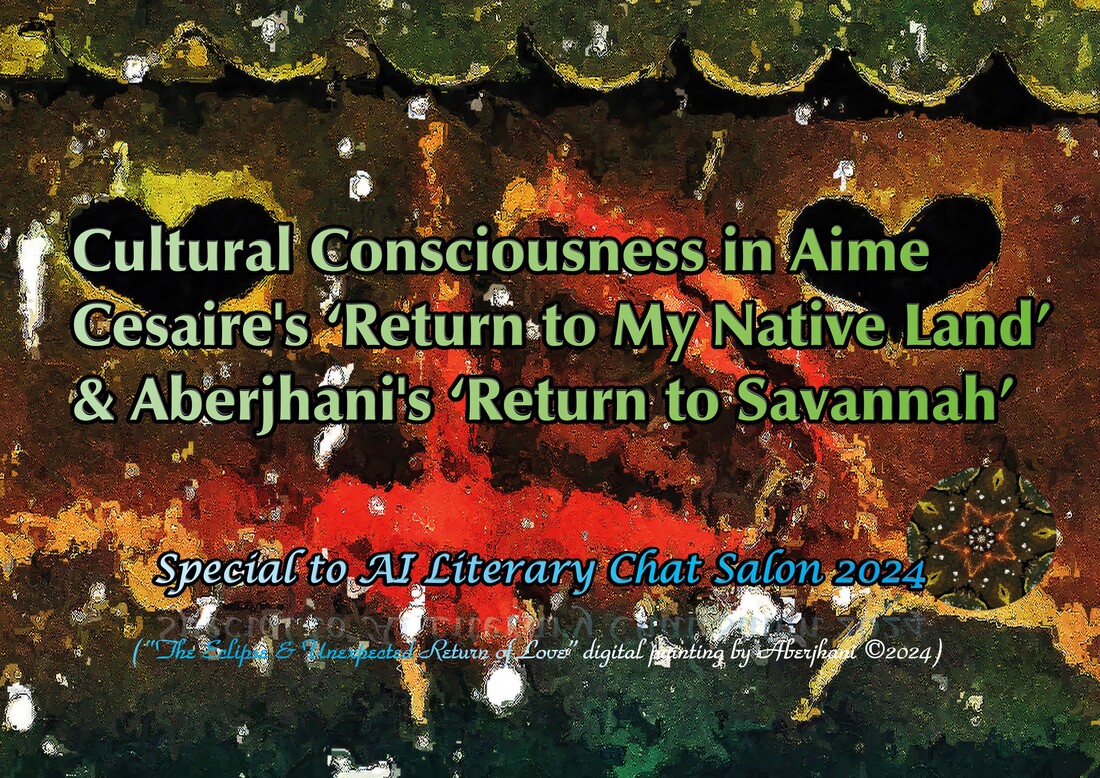
Cultural Consciousness in Aime Cesaire's ‘Return to My Native Land’ & Aberjhani's ‘Return to Savannah’

4/7/2024

0 Comments

 
Picture
(“The Eclipse & Unexpected Return of Love” digital painting by Aberjhani ©2024)
When it comes to Modern Literary Studies, the exploration of cultural identity, social justice, and human experience are often paramount themes. Aime Cesaire's (1913-2008) poem Return to My Native Land (1939) and Aberjhani's "Return to Savannah" (1997) are two exemplary works that delve into these themes, drawing upon historical, philosophical, and biographical insights. This comparative literary analysis examines how these poems resonate with contemporary discourses such as Critical Race Theory, Black Lives Matter, and WOKE theory, while also embodying values significant to humanity as a whole.

Cultural Context and Literary Tradition

In considering the significance of these poems for readers and scholars alike, it becomes evident that they offer invaluable insights into the complexities of modern Black Studies and the broader human experience. Whether studied during National Poetry Month, Education Week, Black History Month, or on World Poetry Day, both works serve as poignant reminders of the enduring power of poetry to provoke thought, inspire empathy, and catalyze change.

Aberjhani, in his 2007 Goodreads review of Cesaire’s book, aptly describes Return to My Native Land as a product of literary fusion, drawing upon the Negritude movement, the Harlem Renaissance, and French surrealism. This amalgamation infuses Cesaire's work with rich cultural and political nuances, addressing racism, class oppression, and the human condition. The following excerpt provide a small example from Return to My Native Land:

In this inert town, this sorry crowd under the sun, taking part in nothing which expresses, asserts, frees itself in the broad daylight of its own land. Nor in Empress Joséphine of the French dreaming high, high above negridom. Nor in the liberator rigidified in its liberation of whitened stone. Nor in the conquistador. Nor in this contempt, nor in this freedom, nor in this boldness.
At the brink of dawn, this inert city and its far beyond of leprosies, of consumption, of famines, of fears crouching in the ravines of fears, hoisted in the trees of fears, burrowed in the ground, of fears adrift in the sky, of fears piled up and its fumaroles of anguish.

At the brink of dawn, the morne, forgotten, forgetful of blowing up.

 At the brink of dawn, the morne with its nervous and docile hoof – its malarial blood puts the sun to rout with its overheated pulses.

At the brink of dawn, the repressed fire of the morne, like a sob gagged on the verge of bloodthirsty outburst, searching for an evasive and unconscious ignition. (Césaire, Aimé. Notebook of a Return to My Native Land: 4. Bloodaxe contemporary French poets, pp. 103-104. Bloodaxe Books. Kindle Edition.)


As for Aberjhani’s Return to Savannah, inspired by Cesaire's work, the poem carries forward the legacy previously noted. It does this by weaving together elements of African-American experience, Southern history, and personal reflection. Both works can be situated within the tradition of protest poetry, which seeks to challenge systems of oppression and assert the dignity of marginalized communities. Additionally, they contribute to the broader tradition of lyric poetry, using language and imagery to evoke emotional and philosophical truths. The lines that follow are from Return to Savannah:

Legends tell the tourists
that spectres roam this city
but I’ve no need of tales
to explain
the red-eyed shadows
hopping like squirrels
through the greenless branches
of my immediate apprehension.
I remember when they died.

Stand amazed, now,
watching them haunt
reflections of their former lives.

The tourists hear one story
but let me tell you another:
like the one about WillieMae
who had 14 children, 9 they say
still living,  just like she is
a blackwoman working split shifts
at what used to be the old
Desoto Hilton Hotel.
14 children, 9 still living
spanking, feeding, loving her brood
in-between preparing pastries
for people who’d rather not know.

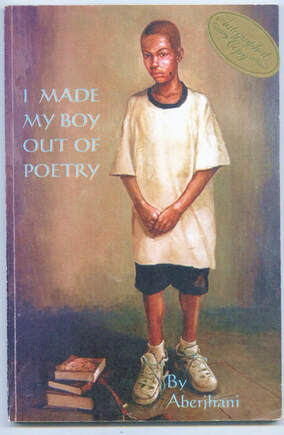
          (Aberjhani, I Made My Boy Out of Poetry, p. 30, Washington Publications, 1998)

Critical Race Theory and Black Lives Matter

It obvious from the above excerpts that both poems engage with the themes of racial identity, systemic oppression, and cultural resilience, resonating deeply with the principles of Critical Race Theory and the goals of the Black Lives Matter movement. Cesaire's exploration of colonialism and cultural alienation speaks to the enduring legacy of racism and imperialism, while Aberjhani's portrayal of African-American life in late 1990s Savannah documented the ongoing realities of systemic racism and social inequality. Through their poetic visions, both authors challenge readers to confront the injustices of the past and present, and imagine a more just and equitable future.
Picture
Original 1st edition 1997 cover of I MADE MY BOY OUT OF POETRY, book by Aberjhani featuring art by Gustave Blache III.
In addition, their work also reflects to a powerful degree the concept of being "woke," which encompasses an awareness of social injustices and a commitment to activism and change. The authors’ poems exemplify this ethos by inviting readers to awaken to the realities of various social inequities surrounding them. By centering the experiences of marginalized communities and amplifying their voices, these works contribute to a broader consciousness of social justice and collective liberation. They remind readers of the power of literature to inspire empathy, provoke critical reflection, and ignite social change.

Human Values and Universal Truths

Beyond their specific cultural and historical contexts, both poems embody values that are universally significant to humanity. Cesaire's lyrical meditation on identity, belonging, and the search for meaning resonates with readers of all backgrounds, prompting considerations of their own sense of self and place in the world. Aberjhani's poignant portrayal of resilience, community, and the enduring power of the human spirit speaks to the universal quest for dignity, justice, and love. By tapping into these universal truths, these poems transcend their particularities and speak to the shared humanity that unites us all.
Picture
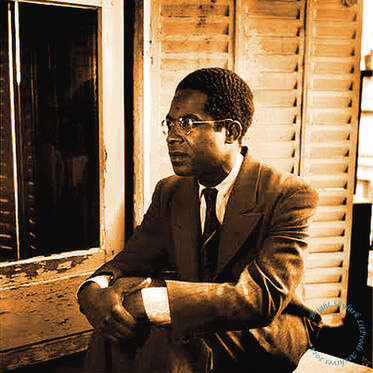
Poet and political leader Aimé Césaire (1913-2008) photo edit (2024) by Aberjhani based on original unaccredited pr still.
Notably, in Return to My Native Land, Cesaire writes, "My negritude is not a stone, its deafness hurled against the clamor of the day," emphasizing the enduring strength of Black identity in the face of adversity, much the way members of other cultural groups have relied on long-standing values to survive persecution, or even genocide. Similarly, Aberjhani's portrayal of “WillieMae” in Return to Savannah underscores the inherent dignity and humanity of marginalized individuals, regardless of their societal status.

Literary Traditions and Contemporary Significance

Both Cesaire and Aberjhani draw from a rich tradition of literary expression rooted in the experiences of Black people across the globe. Cesaire’s fusion of prose and poetry reflects the experimental spirit of French surrealism while also echoing the lyrical cadence of Harlem Renaissance poets like Langston Hughes and Claude McKay. Similarly, Aberjhani’s narrative style and thematic depth align with the traditions of African-American literature, particularly the works of poets like Maya Angelou and Amiri Baraka.

The significance of studying these works during National Poetry Month, Education Week, or Black History Month lies in their ability to foster critical thinking, cultural awareness, and empathy among students. By engaging with themes of identity, justice, and resilience, readers can gain a deeper understanding of the complexities of the human experience and the enduring legacy of racial injustice. Furthermore, these works serve as catalysts for meaningful discussions about the intersections of race, class, and power in modern society.

Contemporary Poets Following Similar Literary Traditions

A number of contemporary poets share similarities with Cesaire and Aberjhani in their exploration of identity, history, and the impact of colonialism and racism. Their works serve as poignant reports on the complexities of the human experience. The following are a four examples of authors whose writings challenge readers to confront uncomfortable truths and consider alternative narratives of belonging and heritage:
  1. CLAUDIA RANKINE: Known for her collection "Citizen: An American Lyric," Rankine's work addresses themes of race, identity, and belonging in contemporary America. Like Cesaire, she delves into the complexities of racial identity and colonial history, offering powerful reflections on the Black experience.
  2. WARSAN SHIRE: Shire's poetry often explores themes of displacement, migration, and cultural identity, echoing Cesaire's exploration of his Caribbean heritage and the impact of colonialism. Her work, such as "Teaching My Mother How to Give Birth," captures the struggle for belonging and the search for roots in a globalized world.
  3. OCEAN VUONG: Vuong's poetry, as seen in his collection "Night Sky with Exit Wounds," delves into personal and collective trauma, often exploring themes of war, exile, and intergenerational memory. Like Aberjhani, he grapples with the complexities of identity and history, weaving together personal narrative with broader socio-political reflections.
  4. JERICHO BROWN: Brown's poetry, particularly in his collection "The Tradition," explores themes of race, sexuality, and history in America. Much like Aberjhani's "Return to Savannah," Brown's work confronts the legacy of slavery and the ongoing struggle for racial justice, offering a nuanced exploration of African American identity and heritage.


Lesson Plan: Teaching 
Césaire and Aberjhani Simultaneously

OBJECTIVE: To explore the themes, literary techniques, and historical contexts of Cesaire’s “Return to My Native Land” and Aberjhani’s “Return to Savannah” while fostering critical thinking and cultural awareness.

1. Pre-Reading Activity:
  • Introduce students to the historical and cultural contexts of Negritude, the Harlem Renaissance, and French surrealism.
  • Discuss the significance of poetry as a medium for social and political commentary.
2. Reading and Analysis:
  • Divide students into small groups and assign each group either Cesaire’s poem or Aberjhani’s poem.
  • Ask students to analyze the themes, imagery, and literary techniques employed by the respective authors.
  • Facilitate discussions on the historical and philosophical implications of the poems.
3. Comparative Analysis:
  • Bring the groups together to compare and contrast Cesaire’s and Aberjhani’s works.
  • Encourage students to identify common themes, motifs, and stylistic elements.
  • Discuss how each poem reflects the cultural and historical contexts of its respective author.
4. Reflection and Discussion:
  • Lead a class discussion on the contemporary relevance of Cesaire’s and Aberjhani’s works in the context of Black Studies and social justice movements.
  • Encourage students to reflect on how the poems contribute to their understanding of identity, history, and human experience.
5. Extension Activities:
  • Invite students to create their own poems inspired by the themes and styles of Cesaire and Aberjhani.
  • Research and present on other contemporary poets whose works align with the literary traditions explored in the lesson.

In Conclusion

The works of Aimé Césaire and Aberjhani offer profound insights into the complexities within Black Studies and beyond. By studying their works, students can gain a deeper of Black identity, history, and human existence. Through their exploration of themes such as memory, resilience, and social justice, these poets contribute to ongoing conversations understanding of the enduring legacy of racial injustice and the universal values of dignity, justice, and empathy.
 
By ChatGPT Op-Ed Contributor 4114
Special to AI Literary Chat Salon 2024


    Contact AI Literary Chat Salon

Submit
0 Comments

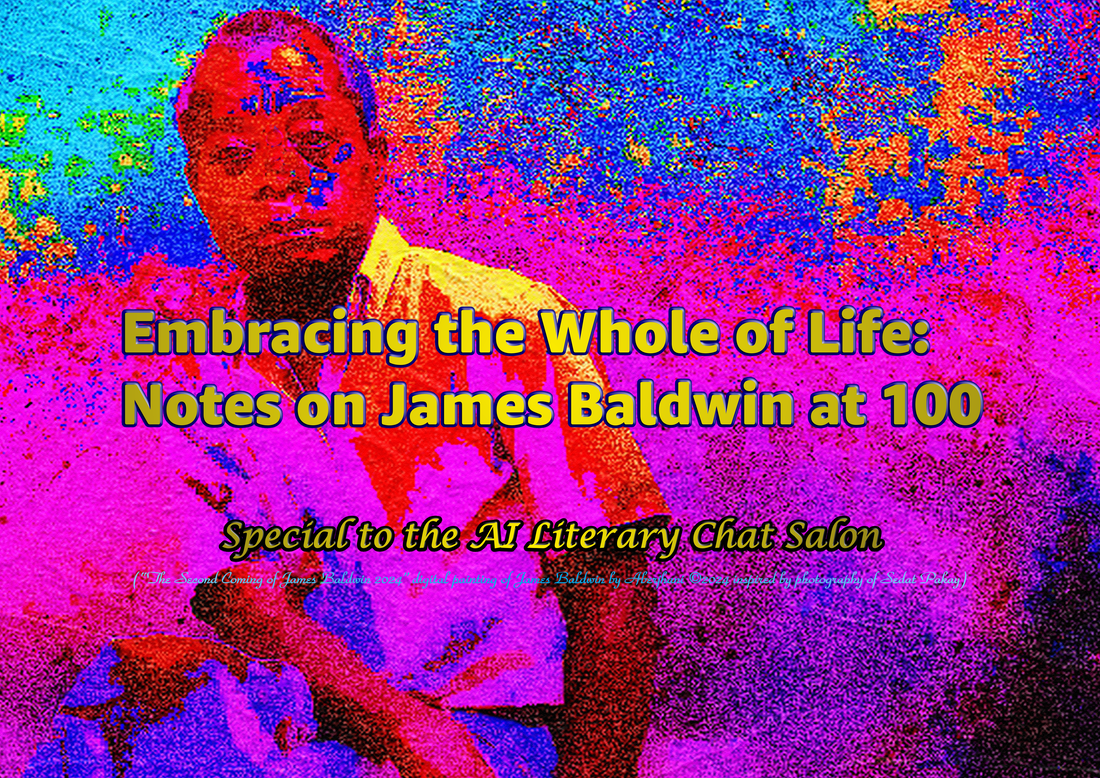
Embracing the Whole of Life: Notes on James Baldwin at 100

2/3/2024

0 Comments

 
Picture
(“Embracing the Whole of Life” digital painting of James Baldwin by Aberjhani ©2024 modeled after original photography by Sedat Pakay)
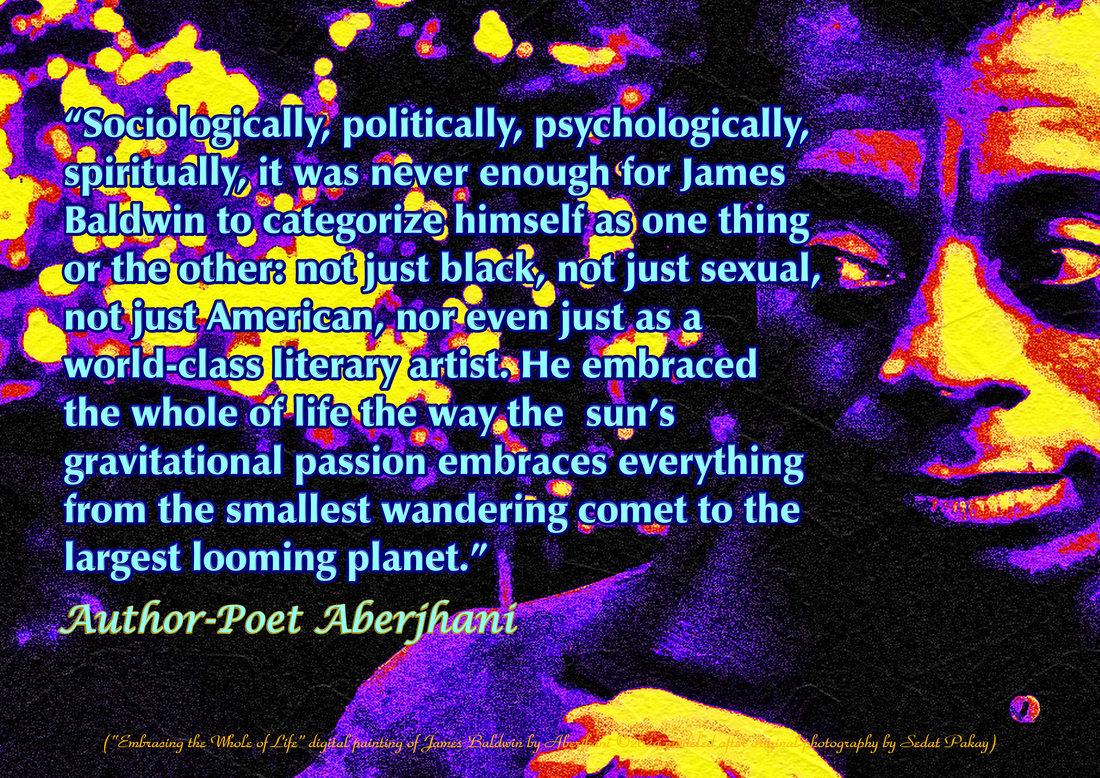
​The centennial celebration of the birth of author-activist James Baldwin in 2024 offers a unique opportunity for educators, students, advocates, and various groups to delve into the profound sociopolitical, psychological, and spiritual dimensions of Baldwin's life and work. Of particular use in this endeavor may be this observation made by author-poet-artist Aberjhani: 
“Sociologically, politically, psychologically, spiritually, it was never enough for James Baldwin to categorize himself as one thing or the other: not just black, not just sexual, not just American, nor even just as a world-class literary artist. He embraced the whole of life the way the sun’s gravitational passion embraces everything from the smallest wandering comet to the largest looming planet.” (Aberjhani) 

​In this article, we explore the ways in which individuals and organizations can advantageously frame presentations or programs around the above text, referencing such factors as the significance of the Google front-page doodle honoring James Baldwin launched on February 1, 2024. Additionally, contemporary black authors or philosophers whose work aligns with the quote will also be identified.

​​Aberjhani's insightful statement encapsulates Baldwin's approach to identity and existence, emphasizing the need to resist simplistic categorizations. As an accomplished author, poet, and artist in his own right, he brings a unique perspective to his assessment. As an African American writer deeply engaged with cultural and sociopolitical issues, his insights into Baldwin's all-encompassing embrace of life stem from a shared understanding of the complexities of identity and societal structures. They are further bolstered by extensive body of work that includes: These Black and Blue Red Zone Days, co-authorship of Encyclopedia of the Harlem Renaissance (Facts On File/Infobase Publishing), the frequently-quoted The River of Winged Dreams, and Dreams of the Immortal City Savannah. 

Embracing Complexity in Identity

Picture
A literary giant of the 20th century, Baldwin defied conventional categorizations by challenging societal norms and embracing the complexity of human identity. Aberjhani's text underscores the author's refusal to be confined to singular labels, be they racial, sexual, or national.
​
In the sociopolitical landscape, this perspective encourages a nuanced understanding of identity that goes beyond superficial divisions, fostering inclusivity and appreciation for the diverse experiences that shape individuals. It effectively illustrates how Baldwin challenged conventional norms to support fostering a holistic understanding of human experience. The metaphorical reference to the sun's gravitational pull evokes the idea that Baldwin's impact encompasses everything within its reach, from individual identities to institutional organizations and global issues.

In commemorating Baldwin's centennial, educators, activists, and cultural organizations can draw inspiration from Aberjhani's assessment to frame presentations or programs that celebrate the inclusivity inherent in Baldwin's work. This inclusive lens is not only relevant to the exploration of his legacy but also resonates with contemporary sociopolitical discourse on intersectionality, emphasizing the interconnectedness of various social categories.

The Google Doodle as a Symbolic Acknowledgment

​The significance of Google featuring a doodle on its front page on February 1, 2024, honoring Baldwin cannot be overstated. Doodles are a form of symbolic acknowledgment, and in this case they serve as a public recognition of one author’s enduring influence. 

​Created by the New York-based artist Jon Key, the doodle may incorporate visual elements reflecting the author-activist’s commitment to equality, “speaking truth to power,” and his unapologetic stance against racial injustices. It is in this visual depiction, though uniquely representative of artist Key’s preferred palette and style, that the resonance with Aberjhani's statement becomes apparent – capturing the essence of a focused Baldwin's gravitational pull, at work with pen in hand drawing attention to the interconnectedness of the many facets of life that he embraced in his writings.
​
Educators, students, and advocates can leverage this visual representation as a starting point for discussions on the multifaceted nature of identity and the impact of Baldwin's contributions to literature and social discourse. In the words of artist Key himself, as shared on Google Doodles: “Entering rooms and lecture halls, bravely and brazenly, Baldwin was not afraid to speak his mind and advocate for marginalized voices. With the work I create, I am trying to manifest environments and community structures imbued with truth, pride and love––tenets that I think are exemplified by Baldwin’s texts and life.” 

Aligning with An Expansive World View

​To further contextualize the subject text, it helps to identify other contemporary black authors and philosophers whose work aligns with Baldwin's expansive worldview. Ta-Nehisi Coates, through works like Between the World and Me, explores the complexities of being black in America, addressing issues of systemic racism and the ongoing struggle for racial justice. Chimamanda Ngozi Adichie, a Nigerian author, challenges single narratives and explores the intersectionality of identity in works such as Americanah. Both authors contribute to the ongoing discourse on identity, echoing Baldwin's commitment to embracing life's entirety.

LESSON PLAN FOR EDUCATORS

To engage students in meaningful discussions on diversity, social justice, antiracism, and James Baldwin, educators can adopt Aberjhani's observation as a guiding principle. The following proposed lesson plan outlines a structured approach:

Lesson Title: Embracing Complexity: A Journey through James Baldwin's Worldview
OBJECTIVE: Students will gain a nuanced understanding of identity, diversity, and social justice through the exploration of James Baldwin's life and work.
Students will analyze contemporary works by black authors and philosophers to draw connections with Baldwin's legacy.

Activities: Introduction (1 class period)
:
Present Aberjhani's statement and discuss its implications.
Analyze the Google front-page doodle launched on February 1, 2024, as a visual representation of Baldwin's legacy.

Biographical Exploration (2 class periods)
:
Explore James Baldwin's life, major works, and key themes in his writings.
Discuss Baldwin's resistance to categorization and his impact on sociopolitical discourse.

​Contemporary Connections (2 class periods)
:
Introduce Ta-Nehisi Coates and Chimamanda Ngozi Adichie as contemporary voices exploring identity.
Analyze excerpts from their works, drawing parallels to Baldwin's ideas.
Group Discussions and Presentations (2 class periods):
Divide students into small groups to discuss specific aspects of Baldwin's legacy and its contemporary relevance.
Each group will present their findings, fostering collaborative learning.

Creative Expression (2 class periods):
Encourage students to express their understanding through creative projects such as artwork, poetry, or essays.
Discuss how creative expression can serve as a powerful tool for exploring complex themes.

Reflection and Discussion (1 class period):
Facilitate a class-wide reflection on the lessons learned.
Discuss the applicability of Baldwin's ideas in addressing current social issues.

​Assessment: Evaluate students based on their participation in group discussions, the quality of creative projects, and a reflective essay on the relevance of Baldwin's legacy in today's society.

Conclusion

​In commemorating James Baldwin's centennial, embracing the whole of life becomes a guiding principle for educators, students, advocates, and organizations. The suggested text serves as a beacon, illuminating the path toward a deeper understanding of identity, diversity, and social justice. By incorporating different contemporary voices and creative expressions into the exploration of Baldwin's legacy, educators can inspire a new generation to engage critically with the complexities of the human experience, fostering a commitment to inclusivity and social progress.

By ChatGPT Op-Ed Contributor 4114
Special to AI Literary Chat Salon 2nd Volume 2024

    To suggest stories for AI Literary Chat Salon or contact Aberjhani at Bright Skylark Literary Prods  

Submit
0 Comments

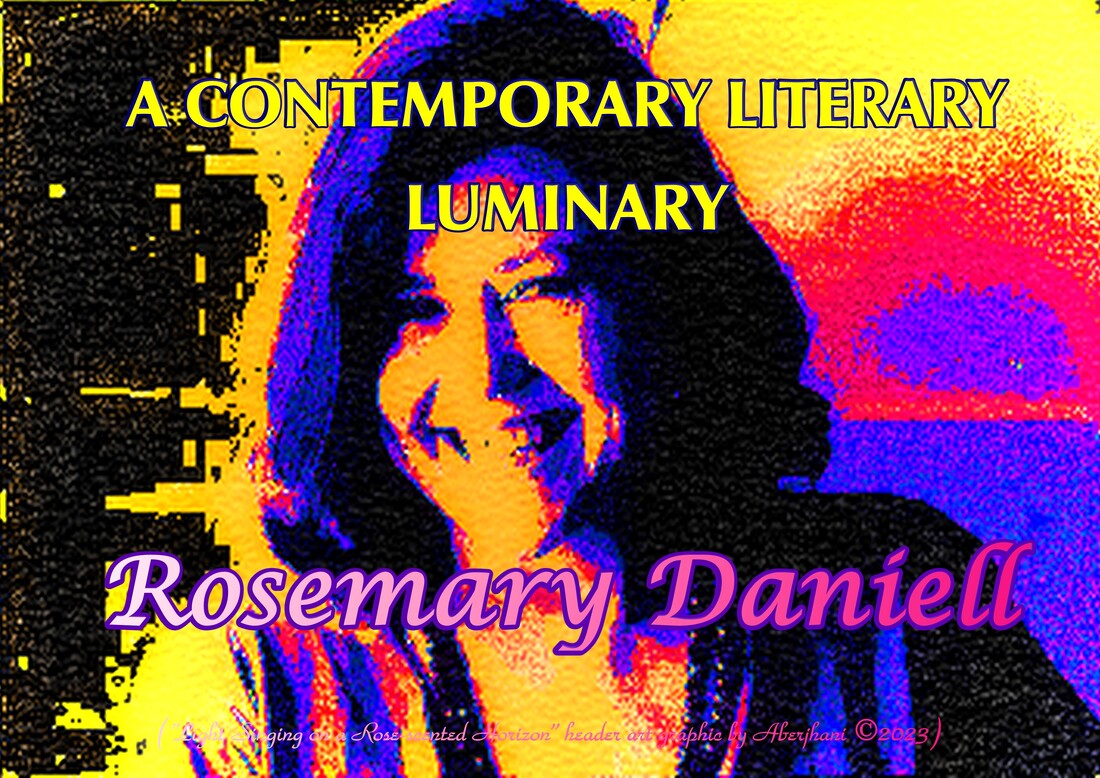
A Contemporary Literary Luminary: Rosemary Daniell

9/21/2023

0 Comments

 
Picture
(“Light Singing on a Rose-scented Horizon” header art graphic by Aberjhani ©2023)


​INTRODUCTION: A MULTIFACETED AUTHOR

Rosemary Daniell, a multifaceted author, poet, advocate, and educator, has made an indelible mark on contemporary literature in Savannah, Georgia, the United States, and possibly the world. Her compelling works of poetry, fiction, essays, and nonfiction not only resonate with readers on a personal level. They also embody progressive principles of feminism and humanism that make her a renowned influential figure on the literary landscape.
​
This Literary Chat Salon article explores what sets Daniell apart as one of today’s most notable contemporary authors, touching upon her importance in the history of Savannah's literature, her feminist influence, and her potential impact on future generations of diverse authors and global literary culture. It concludes with a sample lesson plan for teaching classes on the author's considerable literary corpus and impact upon contemporary cultural arts. 

I. FEMINIST THEMES IN THE AUTHOR’S WORK

Rosemary Daniell's literary journey is steeped in feminist themes that have resonated with readers for decades. Her exploration of the female experience, sexuality, and personal liberation has drawn comparisons to notable feminist authors of the past and present.
​
To appreciate her feminist contributions, we must draw parallels with other influential women authors. Two such historic, or herstoric, figures are Virginia Woolf (1882-1941) and Sylvia Plath (1932-1963). Like Daniell, Woolf and Plath delved into the complexities of female identity, mental health, and societal expectations. Woolf's A Room of One's Own  and Plath's The Bell Jar resonate with themes later evident in Daniell's commitment to breaking free from societal constraints and finding one's authentic self. 
It is also worth considering how the author’s courage in addressing topics related to sex, sexuality, and personal experiences reflects the same kind of fearlessness demonstrated by Audre Lorde (1934-1992) in works like Zami, a New Spelling of My Name, and Undersong, Chosen Poems Old and New. Lorde's advocacy for using one's personal experiences to create powerful literature resonates with Daniell's daring approach.

In the modern era, second-wave feminist Erica Jong described the award-winning author of The Murderous Sky: Poems of Madness and Mercy, as “one of the women by whom our age will be known in times to come.”

Daniell's exploration of female identity, sexual liberation, and personal empowerment in works like Fort Bragg and Other Points South, A Sexual Tour of the Deep South, The Woman Who Spilled Words All Over Herself, and Secrets of the Zona Rosa, like works by Woolf and Plath and Jong, has already inspired many to consider women’s realities from fresh perspectives. Her unapologetic embrace of feminine experiences and intuitions challenges the literary world to acknowledge and celebrate women's voices and will likely continue to inspire future generations of women writers.

II. CONTRIBUTION TO THE HISTORY OF LITERATURE IN SAVANNAH

With its rich literary heritage, Savannah has been the backdrop for many influential writers. Daniell may have been born in Atlanta, but her impact on the literary history of her adopted vibrant home is undeniable. It has not only provided the locale for some of her most compelling work, but provided the real-world setting of her Zona Rosa Way teaching enterprise.
​
Moreover, along with such talents as John Berendt, Flannery O’Connor (1925-1964), and Johnny Mercer (1909-1976), she was 1 of 37 authors published in the celebrated Literary Savannah travel anthology. Her contribution to the anthology is an excerpt from the book Sleeping with Soldiers (In Search of the Macho Man). The following quote from the same volume appears on the front of Literary Savannah’s first edition: “Savannah is a lovely, pastel dream of tight cobbled streets…. There are legendary scenes…extreme enough to rival any dreamed up by Tennessee Williams.”
Picture
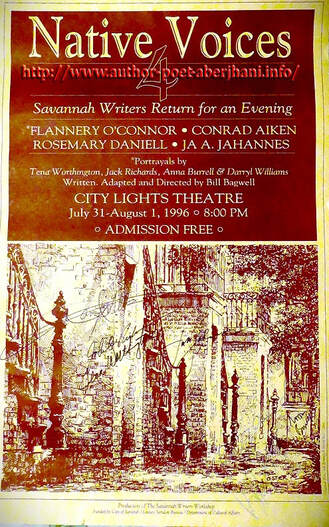
Flyer for 1996 NATIVE VOICES production, presented by the Savannah Writers Workshop and featuring portrayals of 4 iconic Savannah authors.
​In addition, the author’s life story and creative vision were dramatized––alongside that of luminaries  O'Connor, Ja A. Jahannes (1942-2015), and Conrad Aiken (1889-1973)––in the 1996 stage production NATIVE VOICES. Such an honor testifies to her significance in Savannah's cultural arts tapestry, showcasing her role and status as a contemporary torchbearer of the city's literary tradition. Her literary contributions continue to enrich the city's cultural landscape.
While Savannah boasts a history of celebrated authors, Daniell's work stands as a modern voice that bridges the gap between tradition and innovation. One small example of this, and why it matters, can be seen when contrasting the body of her work with that of the celebrated O’Connor:

While both women are natives of Georgia, one of the most striking differences between Daniell and O'Connor is their narrative style. Flannery O'Connor, celebrated for her short stories and novels, is renowned for her use of dark humor, grotesque characters, and the integration of her Catholic faith into her narratives. Her stories often explore themes of moral decay, redemption, and the inescapable presence of the divine in everyday life. In contrast, Rosemary Daniell adopts a more personal and confessional tone in her works. She is known for her autobiographical essays and poetry, which often delve into intimate, emotional, and at times, explicit content. Daniell's prose, while distinctly Southern, is rooted in the realm of personal experience and self-exploration.

Both authors, however, share a profound connection to their Southern heritage, and this connection manifests itself in their writings. Both authors grapple with themes of morality and religion, albeit in distinct ways. O'Connor's stories are permeated with religious symbolism and explore the collision of grace and sin. Her characters often undergo moral crises, leading to dramatic and often violent resolutions. In contrast, Daniell's works, particularly her memoirs, delve into individual struggles with spirituality and morality, as well as mortality, but are less overtly religious in their themes. She questions the traditional values of the South and navigates the complexities of modern life. 

III. The Element of Courage

Courage as demonstrated by the themes and subjects which writers present to readers has often stood among the qualities assessed by literary critics to determine the overall value of an author’s work. The unreserved boldness found in British author George Orwell’s (1903-1950) fictionalized critiques of totalitarianism is one example of such bravery that continues to inspire readers and leaders today.  So is the fearlessness readers encounter in British-Zimbabwean Doris Lessing’s (1919-2013) extensive body of work dissecting the impact of male-determined priorities within male-dominated societies upon individual female psyches.

Similar uncompromising daring has been a trademark feature of Rosemary Daniell’s poetry and prose since the beginning of her triumphant career. More than a decade before John Berendt pulled open the moss curtain of cultivated charm concealing some of Savannah’s less appealing quirks with 1994’s publication of Midnight in the Garden of Good and Evil, Daniell dismissed magnolia-scented myths regarding the South with her first memoir, Fatal Flowers: On Sin, Sex and Suicide in the Deep South (1980). As described by publisher Henry Holt & Company for the 1989 edition of the title: “Its taboo-shattering descriptions of sexual awakening and self-fulfillment resonate across generations, representing an everywoman`s account of the struggle for female identity in a South still often dominated by male superiority and rigid sexual mores.”

Her commitment since then has not wavered in this regard. It is sometimes uncomfortably evident when reading the straight-no-chaser poems in  The Murderous Sky: Poems of Madness and Mercy. Nor is it any less astonishing in the heart-wrenching preliminary pages of the author’s highly-anticipated most recent memoir: My Beautiful Tigers: Forty Years as the Mother of an Opioid Addicted Daughter and a Schizophrenic Son. The fact that both these books have won a coveted  William Faulkner-William Award attest to the intense power and enduring relevance of the author’s  writings. The subjects of suicide, mental illness, and drug addictions tend to be issues with which many (maybe most) Americans would rather not deal. In this current 21st-century hour, however, avoiding them is no longer an option. Daniell’s work provides readers with insights for coping, surviving, healing, and evolving with their humanity mostly intact.

IV. Potential Impact on Diverse Authors and Global Literary Culture

Daniell's legacy extends beyond her immediate literary circle, offering valuable lessons and inspiration for aspiring authors from diverse backgrounds. Her emphasis on sisterhood, self-expression, and empowerment, as seen in her writings and the Zona Rosa workshop founded by her, serves as a beacon for emerging and marginalized voices in the literary world. Moreover, the universal themes explored in the author’s work, such as love, identity, woundedness, and resilience, transcend geographical boundaries. 
​As her work continues to gain recognition and influence, it has the potential to help shape global literary culture, fostering a greater appreciation for diverse voices and experiences. Her legacy holds the potential to encourage a new generation of diverse authors to embrace their unique perspectives and narratives. What this might or might not mean as women around the world continue to demand fair and equal consideration in their respective communities––such as India, Afghanistan, and Saudi Arabia––makes for exciting possibilities. 

​V. LESSON PLAN FOR TEACHING ROSEMARY DANIELL'S WORK

OBJECTIVE: To introduce students to the life and works of author Rosemary Daniell and encourage critical analysis of her feminist themes and overall literary impact.
  • Pre-Reading Activities: a. Briefly introduce students to author via her background, and her significance in contemporary literature. b. Discuss the concept of feminism and its relevance in literature.

  • Reading Selections: a. Assign excerpts from Daniell's works, such as The Woman Who Spilled Words All Over Herself and Secrets of the Zona Rosa, for in-class or at-home reading. b. Encourage students to annotate and reflect on key themes, literary techniques, and their personal responses.

  • Class Discussions: a. Facilitate discussions on Daniell's portrayal of female experiences, sexuality, and self-discovery. b. Encourage students to draw connections between her work and the broader feminist literary tradition. c. Explore the impact of her work on contemporary literature.

  • Creative Writing Exercise: a. Ask students to write a short piece inspired by Daniell's themes, incorporating their own experiences and perspectives. b. Share and discuss these creative pieces in class.

  • Research Project: a. Assign a research project where students investigate Daniell's influence on contemporary literature and her role in Savannah's literary history. b. Have students present their findings to the class.
    ​
  • Final Reflection: a. Encourage students to reflect on what they have learned about feminism, diverse voices in literature, and the potential impact of their own writing. b. Invite them to share their thoughts on the author’s lasting legacy.

CONCLUSION

Rosemary Daniell's journey as an author-poet-educator has positioned her as a leading literary light in city of Savannah, the state of Georgia, and the broader literary landscape of the United States. Her powerful feminist themes, acclaimed publications in multiple genres, and contributions to Savannah's literary history have made her a notably formidable and influential 21st century author of legendary status. As her work and presence continue to resonate with readers and writers alike, her legacy holds the promise of helping to shape the future of literature and empowering new generations of authors for a very long time.

By Chat Salon Contributor 1122
with editorial input by Aberjhani ©2023

    Contact the AI Literary Chat Salon 

Submit
0 Comments
<<Previous

    Articles in AI Literary Chat Salon are written in partnership with chat bots to achieve a wide spectrum of balanced objective input and authentic human considerations. All feedback related to posts welcomed.

    RSS Feed

    Archives

    December 2025
    May 2025
    March 2025
    February 2025
    August 2024
    June 2024
    April 2024
    February 2024
    November 2023
    October 2023
    September 2023
    August 2023
    July 2023

    Categories

    All
    1925 Survey Graphic Magazine
    2023 Headlines
    2023 Top Stories
    2024 Headlines
    2024 Top Headlines
    2024 U.S. Presidential Election
    2025
    2025 Top Headlines
    20th Anniversary
    20th Century Authors
    20th Century Literature
    20th Century Poets
    21st Century Artists
    21st Century Authors
    21st Century Influencers
    21st Century Innovations
    21st Century Photographers
    21st Century Poets
    21st Century Presidents
    21st Century Thinkers
    Aberjhani Examiner Writings
    Aberjhani On The Age Of AI
    Aberjhani On The AI Revolution
    Aberjhani's AI Literary Chat Salon
    Ada Limon
    Advanced Placement African American Studies
    Advanced Placement African-American Studies
    Aesthetic Vision
    African American Authors
    African-American Authors
    African-American Expats
    African American Legacies
    African-American Legacies
    African American Men
    African-American Men
    African Americans
    African American Studies
    African-American Studies
    African-American Women
    African Traditions
    African Voices Magazine
    Age Of AI
    A.I.
    AI
    AI And Author Poet Aberjhani
    AI And Author-Poet Aberjhani
    AI And Creative Artists
    AI And Cultural Arts
    AI And Cultural Bias
    AI And Ethics
    AI And Human Accountability
    AI And Literature
    AI Artists
    AI Authors
    AI Century
    AI Discussions
    AI Editorials
    AI Governance
    AI In The Classroom
    AI In The Modern World
    AI Lit Chat Salon Contributor
    AI Lit Chat Salon Host
    AI Lit-Chat Salon Host
    AI Literary Chat Salon
    Aimé Césaire
    Aimé Césaire
    AI Op Eds
    AI Op-eds
    AI Revolution
    Albert Camus
    Alfred Lord Tennyson
    Alfred North Whitehead
    Allen Ginsberg
    American History
    American Literature
    American Politics
    American Presidents
    And People Of Color)
    Angela Kinamore
    Angel Art
    Angel Art By Aberjhani
    Angelicus
    Angel Of Hope’s Persistent Flight
    Angel Poems
    Angels
    Anti-war Poetry
    Archival Science
    Aretha Franklin
    Aristotle
    Ars Poetica And Other Poems
    Art By Aberjhani
    Artist Author Aberjhani
    Artist-Author Aberjhani
    Artistic Beauty
    Artist-poet Kahlil Gibran
    Artist-poet William Blake
    Art Of Spiritual Surrealism
    Art Reviews
    Audre Lorde
    August 2023
    Author Alex Haley
    Author Artist Aberjhani
    Author-Artist Aberjhani
    Author--artist-documentarian
    Author Biographies
    Authoritarian
    Authoritarianism
    Author James Baldwin
    Author Poet Aberjhani
    Author-Poet Aberjhani
    Autobiography Of Malcolm X
    Autocracy
    Autocracy And Poetry
    Autocracy In America
    Autocratic Attempt
    Autocratic Breakthrough
    Autocratic Consolidation
    Autocratic Transformation
    AXS Examiner
    Barack H. Obama
    Best Books Of 2023
    Best Poetry Of 2023
    Billionaires
    BIPOC (Black
    BIPOC Savannah
    BIPOC Savannah Author Aberjhani
    Black Manhood
    Black People In The U.S.
    Black Poetry Day
    Black Voices
    Black Women In Music
    Book Reviews
    Books
    Books By Aberjhani
    Books By Sandra L. West
    Books By Savannah Authors
    Books By Stanley J. White
    Books By Women
    Books Chapters
    Books Covers
    Bridges
    Bright Skylark Literary Productions
    British Authors
    Buchi Emecheta
    Buddhism
    Camus Combat Writings
    Canadian Authors
    Canadian Literature
    Carl Jung
    Celebrating Books
    Celebrating Literature
    Celebrating The Harlem Renaissance
    Chatbot
    ChatGPt
    ChatGPT Commentaries
    ChatGPT Guest Contributors
    Chat Salon
    Chimamanda Ngozi Adichie
    Chinua Achebe
    Choice Academic Title Award Winners
    Christian Traditions
    Classic Books
    Classic Poetry
    Claudia Rankine
    Clement Alexander Price
    Color Red
    Combat Newspaper
    Community Engagement
    Comparative Literary Analyses
    Compassion
    Conceptual Art By Aberjhani
    Conrad Aiken
    Consumer Financial Protection Bureau
    Contemporary African Writers
    Contemporary Art
    Contemporary Artists
    Contemporary Authors
    Contemporary Poetry
    Contemporary Women's Literature
    Copyrights And AI
    Correcting Disinformation
    Correcting Misinformation
    Courage
    COVID-19 Pandemic
    Creative AI
    Creative Projects
    Creative Resistence
    Creatives
    Creativity
    Critical Race Theory
    Critical Thinking
    Cubism
    Cultural Archives
    Cultural Arts
    Cultural Bias
    Cultural Documentation
    Cultural Heritage
    Cultural Icons
    Cultural Identity
    Cultural Memory
    DEI Diversity Equity Inclusion
    Democracy
    Democratic Spirit
    Digital Art For Sale
    Digital Dialogues
    Digital Transformation
    Disinformation
    Displacement
    Diversity
    Doctors And Nurses
    Documentarians
    DOGE
    Domestic Politics
    Doris Lessing
    Dreams Of The Immortal City Savannah
    Du Bois Crisis Writings
    Duino Elegies
    Dulce Et Decorum Est By Wilfred Owen
    Dystopia
    EBooks By Aberjhani
    Economic Piracy
    Edited By Aberjhani
    Editorial Witness
    -Ed On AI
    Education
    Education Week
    Elegy
    Empowerment
    Encyclopedia Of The Harlem Renaissance
    Encyclopedists
    Erica Jong
    Essential Workers
    Eugene Talmadge Memorial Bridge
    Examiner News Platform
    Existential Editorship
    Existentialist Journalism
    Existentialist Philosophy
    Existentialist Thinkers
    Fact-checking
    Famous Editors
    Farenheit 451
    Feminism
    Flannery O'Connor
    Folklore
    Forced Human Migration
    Free To Read
    French Martinique
    Geneva Academy
    George Orwell
    Georgia Department Of Transportation
    Georgia Port Authority
    Geurrilla Decontexualization
    Global Influencers
    Global Perspectives
    Global Solidarity
    Gospel Music
    Great Britain
    Haiku
    Hamas-Israel War
    Hannah Arendt
    Harlem New York City
    Harlem Renaissance
    Harlem Renaissance Artist Aaron Douglas
    Healers
    Heritage
    Historical Context
    Historical Moments
    Human Artist Aberjhani
    Human Artists
    Human Condition
    Humanity
    Human Rights
    Ideological Divides
    Ideologies
    Ideology
    Image Slideshow
    Inclusiveness
    In Defense Of Democracy
    Indigenous
    Influential Books
    Infrared Photography
    Infrastructure Projects
    Inspiration
    Inspiring
    Institutional Racism
    Intergenerational Memory
    International Authors
    International Humanitarian Law
    International Law
    International Photographers
    International Poets
    International Politics
    Intersectionality
    Iris Formey-Dawson
    Islam
    Israel At War
    Israel-Gaza Conflict
    Israel Hamas War
    Israel-Hamas War
    Italo Calvino
    Ja A. Jahannes
    James Baldwin Centennial
    January Sixers
    Jazz
    Jean Paul Sartre
    Jean-Paul Sartre
    Jericho Brown
    Jerome Meadows
    John Berendt
    Joshua Clover
    Journalism
    Joy Harjo
    Karen E. Johnson
    Karuna
    Lagos
    Language
    Leadership
    Leadership Theory
    Legacy Poetry
    Legendary Authors
    Legends Of Literature
    Lesson Plans
    Lesson Plans For Teaching Poetry
    Life-worlds
    Literary Activism
    Literary Analysis
    Literary Anthology
    Literary Archives
    Literary Biographies
    Literary Contexts
    Literary Correspondence
    Literary Criticism
    Literary Critique
    Literary Essay
    Literary Genres
    Literary Heritage
    Literary Interpretation
    Literary Legacies
    Literary Legends
    Literary Philosophy
    Literary Quotations
    Literary Reviews
    Literary Salon
    Literary Savannah
    Literary Studies
    Literary Symbolism
    Literary Timelines
    Literary Touchstone
    Literary Traditions
    Llifeworld
    Magazines
    Mainstream Media
    Malcolm X 100
    Malcolm X Artwork By Aberjhani
    Malcolm X Centennial
    Malcolm X Day
    March Thomas
    Marginalized Populations
    Martin Heidegger
    Mary C. Lewis
    Masha Gessen
    Midnight Flight Of The Poetry Angels
    Miltary Campaigns
    Misinformation
    Musical Legacies
    Music Education
    Music Industry
    National History Week
    National Poetry Month
    Negritude Movement
    New Book Releases
    New Paperback Releases
    Newspapers
    Nietzsche
    Nigeria
    Nigerian Literature
    Nigerian Society
    Nigerian Writers
    Ocean Vuong
    Octavia E. Butler
    Octavio Paz
    October 7 Attacks On Israel
    Oligarchy
    Orwellian
    Pandemic Art
    Pandemic Literature
    Pandemic Poetry
    Paul Ricoeur
    PEN America
    PEN International
    Pesonalism
    Philosopher Paul Ricoeur
    Philosophical Concepts
    Philosophy
    Photography
    Poem By Aimé Césaire
    Poem In Your Pocket Day
    Poems About Angels
    Poems About Barack Obama
    Poems By Aberjhani
    Poems By Marc Thomas
    Poems By Stanley J. White
    Poet Duncan McNaughton
    Poetics
    Poetic Utterance
    Poet Marc Thomas
    Poet Mary Oliver
    Poetry
    Poetry And Autocracy
    Poetry Books
    Poetry Lesson Plan
    Poets Against War
    Poets And War
    Poets Of War
    Poet T.S. Eliot
    Political Analysis
    Political Critique
    Political Oppression
    Political Philosophy
    Political Theory
    Polysemy
    Post Modernism Creatives
    Post-modernism Creatives
    President Of The United States
    Presidents Day
    Prolific Authors
    Public Discourse
    Purchase Art By Aberjhani
    Quarantine
    Queen Of Soul
    Quotes About James Baldwin
    Quotes By Aberjhani
    Quotes By Malcolm X
    Rainer Maria Rilke
    Ray Bradbury
    Read For Free
    Red
    Resilience
    Return To My Native Land
    Return To Savannah
    Rhythm And Blues
    Rosemary Daniell
    Rotimi Ogunjobi
    Rule Of Law In Armed Conflict
    Savannah Artiststs
    Savannah Authors
    Savannah Georgia
    Savannah-Georgia
    Savannah River Bridge Art By Aberjhani
    Savannah River Crossing Project
    Savannah Tribune
    Sedat Pakay
    Self-education
    September 2023
    Short Stories
    Sigmund Freud
    Simone De Beauvoir
    Social Justice
    Social Media
    Social Philosophy
    Social Theory
    Socio-economic Disenfranchisement
    Sociology
    Songs From The Black Skylark ZPed Music Player
    Speaking Truth To Power
    Spiritual Philosophies
    Spiritual Traditions
    Spiritual Values
    Stanley J. White At The A.I. Literary Chat Salon
    Study Guides
    Surrealism
    Surving Autocracy By Masha Gessen
    Survival
    Suzanne Jackson
    Sylvia Plath
    Taras Shevchenko's
    Teaching African-American History
    Teaching AI
    Teaching Diversity
    Teaching Literature
    Teaching Modules
    Teaching Plans
    Teaching Poetry
    Teaching Work By Aberjhani
    Teaching Work By James Baldwin
    Teaching Writing
    Terrorism
    The Parable Of The Sower
    The Redbridge Review
    There Upon A Bough Of Hope And Audacity
    The River Of Winged Dreams
    These Black And Blue Red Zone Days
    The Waste Land By T.S. Eliot
    Timothy Snyder
    Toronto Writers
    Tracy K. Smith
    Travel Anthology
    Tribute Poems
    Tribute To Canada's Stanley J. White
    Trilogy
    Tupac Shakur
    Ukrainian Poets
    Unheimlich
    United Nations
    U.S. Constitutional Crisis
    U.S. Department Of Education
    U.S. Government
    U.S. In The Middle East
    U.S. President Donald Trump
    U.S. Presidential Election
    U.S. President Joe Biden
    Valentines Day Love Letter
    Virginia Woolf
    Wallace Stevens
    Walt Whitman
    War And Peace
    War In The Middle East
    Warsan Shire
    Washington DC
    Weaponization
    W.E.B. Du Bois
    William Carlos Williams
    William Faulkner-William Award
    Wisława Szymborska
    WOKE Authors
    WOKE Principles
    Wole Soyinka
    Women Authors
    Women In Education
    Women In Music
    Women Poets
    Women's Sexuality
    Women Writers
    Women Writers In Savannah
    Working With AI
    World Literature
    World Poetry Day
    World War II
    Writers And Artists
    Yoko Tawada

    RSS Feed

  • Bright Skylark Literary Productions Sitemap
    • Blog: Visionary Vibes >
      • Aberjhani - Author Biography
      • The SCAD Years
      • The National African American Cultural Arts Examiner Years 2009-2016
      • Blog: Cultural Arts Reviews and Remembrances
      • Bright Skylark News Notes
      • Blog: Sonic Delight Music Reviews >
        • Summer-Song Rhapsody for Michael Jackson: Editorial with Poem
      • Shifting Points of View and the Massacre in Charleston, South Carolina (USA) >
        • Author-Poet Aberjhani in the News
      • 7 Ways to Help Replace Legislated Fear with Informed Compassion
  • Author Statement
    • Books by Aberjhani >
      • Readers & Reviewers on the Writings of Aberjhani
      • Checking in at Goodreads
      • Editing Credits
      • ELEMENTAL: The Power of Illuminated Love (Art and Poetry Gift Book)
      • The River of Winged Dreams
      • The Wisdom of W.E.B. Du Bois
      • Songs from the Black Skylark zPed Music Player: A Novel by Aberjhani
      • I Made My Boy Out of Poetry
      • Journey through the Power of the Rainbow: Quotations from a Life Made Out of Poetry
      • Buy Books by Aberjhani on Amazon
      • 10th Anniversary of Encyclopedia of the Harlem Renaissance
    • Greeting Flannery O'Connor at the Back Door of My Mind >
      • Tribute to Savannah Author Robert T.S. Mickles Sr.
    • Dreams of the Immortal City Savannah >
      • Podcast Prospects 504
  • AI Literary Chat Salon
  • Carousel of Sustainable Compassion
  • Working Scribe Carousel Number 2
    • Awards & Honors
    • My LinkedIn Portfolio Sampler
    • Pop Icon Michael Jackson in Life & Legend
    • Creative Thinkers International
  • Art and Poster Store
    • Blog: Silk-Featherbrush Art and Style
    • Postered Poetics
    • Your Introduction to Original Silk-Featherbrush Art & Style
  • Choose a Cultural Arts Heritage Project to Support
  • Working Scribe Image Carousel 2
  • About Bright Skylark Literary Productions
    • Bright Skylark Values and Motto
  • Famous Quotes of Note
    • Pinterest Page of Quotations
  • Charter for a More Compassionate World
  • As a Poet Thinketh: Poetry by Aberjhani
    • The Bridge of Silver Wings
    • Rainbow-Song for the Angel of Tao by Aberjhani
    • Ode to the Good Black Boots that Served My Soul So Well (poem by Aberjhani)
    • Angel of Remembrance: Candles for September 11, 2001
    • Rainbow-Song for the Angel of Tao: Verse 1
  • Articles and Essays
    • Abbreviated Minds in the News for Wreaking Havoc Worldwide editorial by Aberjhani
    • Iconic Authors Toni Morrison's and Harper Lee's New Works Likely to Influence Dialogues on Race
    • Red Summer: Text and Meaning in Claude McKay’s poem ‘If We Must Die’” part 1 of special 4-part series by Aberjhani
    • A Writer's Journey to Selma, Alabama
    • Justice Remains Elusive in Case of Newly-freed Louis C. Taylor (Part 1 of 2)
    • Sensualized Transcendence: Editorial and Poem on the Art of Jaanika Talts (Part 1)
    • Realms of Emerging Light (Sensualized Transcendence Editorial and Poem on the Art of Jaanika Talts Part 2)
    • Notes on the 150th Anniversary of the Emancipation Proclamation
    • Why Race Mattered in Barack Obama's Re-Election: Editorial and Poem
    • Posted Perspectives on America's 2012 Presidential Election
    • 47 Percenters and Guerrilla Decontextualization: Dreamers and Nightmares
    • Considering Michael Clarke Duncan: Big Black Man Within A Nonsociopoliticohistorical Context (Editorial with Poem)
  • Video Pen & Ink
  • Links and Connections
    • Aberjhani's Guerrilla Decontextualization
  • Contact the Author
  • Working Scribe Image Carousel 2
  • Working Scribe Image Carousel 2
  • Bright Skylark LP Storefront